We walked everywhere, there were few police cars, with one area car covering Hornsey, Highgate and Muswell Hill, and initially we had no radios. Walking the beat alone, and we were always supposed to be alone, was a lonely and hazardous business. You never knew what was around the next corner, and whatever it was you needed to be able to handle it – alone.
I soon learnt that the best way to cope with rowdy youths was to openly confront the loudest in the group, tell him to go away (always very politely, you’ll understand), and if he backed down, the rest would follow. We were lucky, the police were respected, but that had been obtained through years of careful police work. Most of those skills have now been lost.
Walking the beat, standing inconspicuously in the shadows to appear at just the right moment to quell a disturbance, or stop kids sky-larking getting out of hand, and our presence on the streets was important. Today, there are more police officers but much less time is spent on the streets, and few young policemen understand much about dealing with the public.
I have much venom stored up against the Crown Prosecution Service. Thankfully they did not exist in my day, but it seems clear they have led to the demise of the police service I knew and respected. Third rate solicitors and panda cars: the two prime movers in the erosion of law and order in Britain.
Highgate meant breakfast at the postal sorting office, as at that time a postman was deputed to cook breakfast for his colleagues – and us. Those few minutes break every morning on early turn gave me excellent food, good conversation and many useful contacts. Such stop-off points were vital for the young copper. Refreshments at the station were mundane and boring affairs.
We had no canteen, so had to cook our own food. Refreshments took 45 minutes, exactly. Most books and forms used by the police were known by their number and ‘Book 92 Officers at the Station’ sat on the Station Officer’s counter, and PCs had to enter the Front Office, walk past the sergeant in charge, and book in, to the very second. On cold wet nights those 45 minutes flew by, and we had to don raincoats and capes and slosh out into rain, to stand around on deserted street corners in the middle of the night. The small hours can be bleak and depressing when you are alone, cold and hungry – and as a young man I was always hungry.
We made light of many instances. A police officer has some grotty tasks to undertake, and it is those you tend to remember. Death messages: telling someone their loved one has been killed or injured, are always difficult, but even then we could find humour. ‘All those with husbands take one step forward! Go! Where’d you think you’re going Mrs Smith?” Not funny now, but it broke the tension we felt as the Reserve Officer, the officer who ran the station’s communications room, handed the message to you to deal with.
My worst death message came when I had to tell a young Mauritian woman, with three young children, that her husband had been killed by an Underground train. She was completely distraught, knew no-one in this country, so I spent most of that night dealing with her, and the problems she was about to face. It seemed as if her husband, new to this country, had been standing close to the tunnel and had looked to see if the train was coming. It was, and took his head off.
Another lasting memory is of chasing a young man. He’d stolen a car, and as we chased behind him he dumped it at the Goods Yard, Hornsey and ran off. I set off after him, but stopped when he ran across the railway lines. I could hear the train coming, he clearly was too concerned with getting away from me, and ran straight into an express train. Difficult times, as I’d never intended such an outcome. The memory of collecting his remains from the track, putting the pieces into a bucket, remains with me today.
To counter such morbid subjects we did have fun, although much of it now seems bizarre. It’s small incidents that come to mind: the prostitute servicing a client in the back of a client who mouthed to me ‘two minutes’ as client pumped away. I let her go, but her client received the shock of his life, once his two minutes were up. I came into contact with many such ladies of the night, most were amiable enough, but all had terrible tales to tell. I turned down a request from one, who wanted me to act as her pimp. She was earning £300 a week, at a time when I was probably not earning much more than £150 as my monthly salary. She wanted £30 a week, and was willing to give me the rest. I demurred.
Tuesday, January 31, 2006


Monday, January 30, 2006
Metropolitan Police
I’ll try to make these entries short and succinct. Any time spent as a copper unearths a host of stories, but the real truth is that much of police work is mundane, even boring, and in my day it was often cold wet and miserable.
Peel House, the Metropolitan Police Training Centre, then in Victoria, not that far (geographically) away from Buckingham Palace in the centre of London, was run on military lines. We had daily inspections, our heads shorn, as ridicule shouted at the air. That first morning we were inducted, issued with books, instructions and initially treated with respect.
Finally we sat in a classroom awaiting the arrival of the Chief Superintendent in charge of the training school. A fat man, whose uniform sat on him like a sack he waddled into the room, stared at us all dismissively then smashed his fist down on the desk of the young lady sitting by the door, in the front row. ‘Young lady,’ he roared, ‘Get your tits off that desk and your hands off your fanny. You are in the police force now!’
I should have followed my instincts, stood up, railed at him and walked out. My cowardice kicked in, and I sat there, accepting his tirade of abuse, but with sympathy for that poor young woman. The psychology was simple, it was that used by armed forces everywhere. Belittle and then bond. We soon formed ourselves into a protective group, struggling our ways through the 13-week initial training.
We slept in dormitories, but were given some privacy. The large open room was divided by steel partitions, about six-feet high, forming small cubicles. Each room contained a single bed, a metal locker and a small chair. That was it, home for the duration. Training droned on, and some evenings we were allowed out to the Mucky Duck (White Swan) pub around the corner to play bar billiards and drink Watneys Red Barrel. This was life?
All was set to change when I passed out as a police constable, warrant number 153486, a proud member of the best police force in the world, the Metropolitan Police. As we waited to hear where we had been posted I dreamt of walking the beat in Soho, or Chelsea or somewhere exotic. Instead I was sent to Winchmore Hill, near Enfield, with lodgings in the section house above Tottenham police station. It was to be a lonely posting.
Winchmore Hill (YW) police station saw PC 588Y Lockwood as an intruder. I was young, they were all old, many had joined the police as War Reserves, as an alternative to being turned into cannon fodder. Most were lazy bastards, and some tried to swing the old soldier routine. One even tried to make me walk a yard behind him when learning beats. He didn’t win that small skirmish. A young PC would walk the beat with an experienced officer before being let out on his own, and these older men were really only interested in guarding their tea spots, shops and friends who would shelter them from the rigours of walking the streets.
One favourite hidey-hole was at the rear of a greengrocers. In a garage at the rear of the shop was an armchair, a selection of fruit and, at night, a flask of tea! I was nonplussed when I first found this rest home for weary Mr Plods, on the one hand it was a welcome spot on a dank night, but I knew that many officers sat themselves down, and did nothing else all night, having first purloined a meal from one of the restaurants or takeaways. My keen young mind found such behaviour objectionable, I wanted us all to be out there catching baddies!
I didn’t stay long at YW. They agreed to my request to be transferred somewhere busier, so I moved to Highgate (YH) and with that came a move from Tottenham Section House to Elizabeth House, Highgate. After the steel partitions and the grotty atmosphere of Tottenham nick I found Highgate a great relief. My room was small, but on the corner of the building, looking out over lawns, with the gymnasium of Channing School for Girls just over the fence. Pure delight.
Highgate nick(YH) was fun, even though it was only marginally busier than YW. I was one of Sergeant Epps’ merry band, and he taught us well. He was strict but clever and often amusing. The regime was unrelentess and young PC’s were expected to conform, both off and on duty. Three weeks of night duty, from 10pm until 6am, often going to Tottenham Magistrates Court in the morning with arrests made during the night, were followed by six weeks of day duty: one week of late turn, one of early alternatively.
We had four days off a month, spread over to allow one weekend off each month, either a Saturday and Sunday or a Sunday and Monday. Following on from a night duty shift that was not much of a weekend, as you didn’t get up until 2pm on Sunday, and went back at work at 2pm on Tuesday. Social life could get in the way of all this, and I remember one week of early turn when I didn’t get to bed at all. Luckily I was working as a plain-clothes observer on the area car, so could sit down most of the time at work! Keeping my eyes open was a problem that week.
Peel House, the Metropolitan Police Training Centre, then in Victoria, not that far (geographically) away from Buckingham Palace in the centre of London, was run on military lines. We had daily inspections, our heads shorn, as ridicule shouted at the air. That first morning we were inducted, issued with books, instructions and initially treated with respect.
Finally we sat in a classroom awaiting the arrival of the Chief Superintendent in charge of the training school. A fat man, whose uniform sat on him like a sack he waddled into the room, stared at us all dismissively then smashed his fist down on the desk of the young lady sitting by the door, in the front row. ‘Young lady,’ he roared, ‘Get your tits off that desk and your hands off your fanny. You are in the police force now!’
I should have followed my instincts, stood up, railed at him and walked out. My cowardice kicked in, and I sat there, accepting his tirade of abuse, but with sympathy for that poor young woman. The psychology was simple, it was that used by armed forces everywhere. Belittle and then bond. We soon formed ourselves into a protective group, struggling our ways through the 13-week initial training.
We slept in dormitories, but were given some privacy. The large open room was divided by steel partitions, about six-feet high, forming small cubicles. Each room contained a single bed, a metal locker and a small chair. That was it, home for the duration. Training droned on, and some evenings we were allowed out to the Mucky Duck (White Swan) pub around the corner to play bar billiards and drink Watneys Red Barrel. This was life?
All was set to change when I passed out as a police constable, warrant number 153486, a proud member of the best police force in the world, the Metropolitan Police. As we waited to hear where we had been posted I dreamt of walking the beat in Soho, or Chelsea or somewhere exotic. Instead I was sent to Winchmore Hill, near Enfield, with lodgings in the section house above Tottenham police station. It was to be a lonely posting.
Winchmore Hill (YW) police station saw PC 588Y Lockwood as an intruder. I was young, they were all old, many had joined the police as War Reserves, as an alternative to being turned into cannon fodder. Most were lazy bastards, and some tried to swing the old soldier routine. One even tried to make me walk a yard behind him when learning beats. He didn’t win that small skirmish. A young PC would walk the beat with an experienced officer before being let out on his own, and these older men were really only interested in guarding their tea spots, shops and friends who would shelter them from the rigours of walking the streets.
One favourite hidey-hole was at the rear of a greengrocers. In a garage at the rear of the shop was an armchair, a selection of fruit and, at night, a flask of tea! I was nonplussed when I first found this rest home for weary Mr Plods, on the one hand it was a welcome spot on a dank night, but I knew that many officers sat themselves down, and did nothing else all night, having first purloined a meal from one of the restaurants or takeaways. My keen young mind found such behaviour objectionable, I wanted us all to be out there catching baddies!
I didn’t stay long at YW. They agreed to my request to be transferred somewhere busier, so I moved to Highgate (YH) and with that came a move from Tottenham Section House to Elizabeth House, Highgate. After the steel partitions and the grotty atmosphere of Tottenham nick I found Highgate a great relief. My room was small, but on the corner of the building, looking out over lawns, with the gymnasium of Channing School for Girls just over the fence. Pure delight.
Highgate nick(YH) was fun, even though it was only marginally busier than YW. I was one of Sergeant Epps’ merry band, and he taught us well. He was strict but clever and often amusing. The regime was unrelentess and young PC’s were expected to conform, both off and on duty. Three weeks of night duty, from 10pm until 6am, often going to Tottenham Magistrates Court in the morning with arrests made during the night, were followed by six weeks of day duty: one week of late turn, one of early alternatively.
We had four days off a month, spread over to allow one weekend off each month, either a Saturday and Sunday or a Sunday and Monday. Following on from a night duty shift that was not much of a weekend, as you didn’t get up until 2pm on Sunday, and went back at work at 2pm on Tuesday. Social life could get in the way of all this, and I remember one week of early turn when I didn’t get to bed at all. Luckily I was working as a plain-clothes observer on the area car, so could sit down most of the time at work! Keeping my eyes open was a problem that week.
Saturday, January 28, 2006
Work
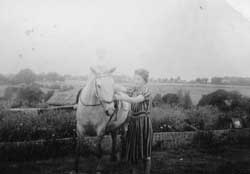 Mum about to mount her pony, although it normally pulled a small trap. I hadn't realised what a good view we had from the back of our house.
I stayed on at school, in the Lower Sixth but it all seemed a bit pointless. I’d no idea where I should be going, and the syllabus was totally irrelevant. John, our next-door-neighbour offered me a job. He ran a secondhand furniture shop, and I’d worked there on Saturdays for several years. That money had helped me go on those marvellous school holidays organised by Dr Ernst Wangerman, our history teacher, who was Austrian.
John wanted me to work in the shop. He had great plans for expansion, and probably regarded me as his substitute son. He and his wife Elsie had no children, and although he was a taciturn man not given to emotion we had a close relationship, stretching back over most of my life. He offered me £20 a week, an unheard of sum in those days. He came to see my parents, and we talked it through. My parents advised against such a step, saying that I needed a job with a pension! I was not yet 18, and the idea of a pension seemed a far-off dream, but I would not have crossed my parents.
 This cowboy suit was to be my pride and joy. Unfortunately it was far too small so I split the trousers in half just after the photo was taken on Xmas morning.
Against my own judgement I turned him down, but used his offer as the catalyst to leave school. My first job was as a scientific instrument technician at St Mary’s Hospital, Colchester. It was stupid job, and I lasted three months before applying to Severalls Hospital, a large mental institution, as a medical laboratory technician. This was a job I loved, but it paid just £4 a week, even when I left three years later it was still only £7, and my first week in the Metropolitan Police paid me £13. Still a long way from John’s £20 offer, and he went on to build one of the most successful stores in East Anglia, eventually handing over to his nephew, a strange man, for whom John had little affection.
Christmas 1963 saw me with a girlfriend, Dinah. She worked in the pharmacy at Severalls and we seemed to be going out together. I was never quite sure why that was happening, but she was a nice girl (no sex in those days), and I was, as always, content to jog along. That Christmas her mother bought me a set of towels. A strange present for a young man, but the message she’d written on the card with the present was mind-blowing. ‘Happy Xmas,’ she wrote, ‘these will come in useful for your bottom drawer’. Hold on a moment! I suddenly realised that my life was being mapped out for me.
 And I now complain about policemen looking young!
As a direct result of that present on 24 February 1964 I found myself at Peel House, Victoria, London on my first day as a Metropolitan Police Constable. It was the only way I could think of to get me out of the rut I was falling into.
Friday, January 27, 2006
First Love
You may be surprised how often love comes into my tale. I love to give love, only rarely have I felt loved, and perhaps deep down inside there is a reason for the inner turmoil that has periodically descended upon my mind. The black dog still comes visiting but he can be handled easily enough these days.
Love is an overwhelming passion, and time has tempered my reaction to its demands, but it is so marvellous to be able to dream, and love allows that indulgence.
I was four years old when I first met Jennie. We were in the same tap-dance class. I wasn’t any good, she was. Childhood passed without too much contact, except for one memorable afternoon in my neighbour’s garage. Jennie’s dance teacher, Elsie Hatfield, lived next door, and one day she came with her mother to see Elsie. As my parents knew hers my mother joined the group, and Jennie and me played in the garden. We kissed gently in that garage, and I was smitten. As we moved into our teens she became even more noticeable. She was beautiful (and still is) and her dancing lessons began to pay dividends as she was often to be seen in local shows and pantomimes.
I was entranced by her. Silly spotty youth! I remember feeling really proud running out to buy her fish and chips during the interval when she was appearing in a pantomime at the Playhouse Theatre, Colchester (now a pub). That I was collecting everyone’s meals was irrelevant, those chips were for Jennie. Bewitched, red-faced and confused, in the soppy way of callow youth. I watched transfixed as Jennie danced and sang ‘You Are My Sunshine’ at the Corn Exchange in Colchester.
This simple song was one that my sister, Janet, could play on the piano, and was often heard at home, so it had special significance when sung by Jennie, who would have known nothing about Janet’s playing. Later I was able to invite her out, on those rare occasions she was back in Colchester. She was then touring in variety, in the summer there were seaside shows, and the winter saw pantomime. Our relationship never really blossomed but luckily enough we have remained in contact for these many years, and still meet for a quiet dinner every year. It’s been a rare friendship, one that I cherish.
I hasten to add that the following poem is a distortion of the truth, as I am not the father of her daughter, but perhaps I wish events had worked out as described. There’s no doubt that it would have made both our mothers very happy!
Jenny
She danced and sang as my Teddy Bear,
Said 'You are my Sunshine' from the lights of the stage.
Soubrette made dreams.
An acrobatic blonde dancing on my tender heart
In Skegness took my virginity without mention.
Too much of this world she knew
Yet she sought not the sailor's game
Was just a child of the 60s
Doing what we all did then
'Where is Love' was to blame
The child that became
Has now a much better name
Than those that fumbled together in her creation.
Genteel and wed
To a producer of plays
Closely watched by her lonely mother
Love is an overwhelming passion, and time has tempered my reaction to its demands, but it is so marvellous to be able to dream, and love allows that indulgence.
I was four years old when I first met Jennie. We were in the same tap-dance class. I wasn’t any good, she was. Childhood passed without too much contact, except for one memorable afternoon in my neighbour’s garage. Jennie’s dance teacher, Elsie Hatfield, lived next door, and one day she came with her mother to see Elsie. As my parents knew hers my mother joined the group, and Jennie and me played in the garden. We kissed gently in that garage, and I was smitten. As we moved into our teens she became even more noticeable. She was beautiful (and still is) and her dancing lessons began to pay dividends as she was often to be seen in local shows and pantomimes.
I was entranced by her. Silly spotty youth! I remember feeling really proud running out to buy her fish and chips during the interval when she was appearing in a pantomime at the Playhouse Theatre, Colchester (now a pub). That I was collecting everyone’s meals was irrelevant, those chips were for Jennie. Bewitched, red-faced and confused, in the soppy way of callow youth. I watched transfixed as Jennie danced and sang ‘You Are My Sunshine’ at the Corn Exchange in Colchester.
This simple song was one that my sister, Janet, could play on the piano, and was often heard at home, so it had special significance when sung by Jennie, who would have known nothing about Janet’s playing. Later I was able to invite her out, on those rare occasions she was back in Colchester. She was then touring in variety, in the summer there were seaside shows, and the winter saw pantomime. Our relationship never really blossomed but luckily enough we have remained in contact for these many years, and still meet for a quiet dinner every year. It’s been a rare friendship, one that I cherish.
I hasten to add that the following poem is a distortion of the truth, as I am not the father of her daughter, but perhaps I wish events had worked out as described. There’s no doubt that it would have made both our mothers very happy!
Jenny
She danced and sang as my Teddy Bear,
Said 'You are my Sunshine' from the lights of the stage.
Soubrette made dreams.
An acrobatic blonde dancing on my tender heart
In Skegness took my virginity without mention.
Too much of this world she knew
Yet she sought not the sailor's game
Was just a child of the 60s
Doing what we all did then
'Where is Love' was to blame
The child that became
Has now a much better name
Than those that fumbled together in her creation.
Genteel and wed
To a producer of plays
Closely watched by her lonely mother
Thursday, January 26, 2006
Achnacone
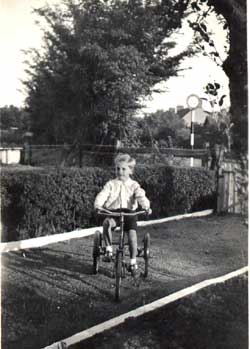 Braiswick, when I was a child, was a quietly select sort of place. In reality it was no more than an extension of a road, Bergholt Road, that led out of Colchester going north through villages to Bures, towards Sudbury. Braiswick ran for about a mile along this road, until it reached the town boundary. There were about 80 houses, a golf club, a sports field and a bus stop – nothing more.
At least that’s what the casual passer-by would have thought. As with all small communities it had hidden depths. The houses were large, owned and occupied by the old elite of the town. The new bourgeoisie chose Lexden, to the west of the town, but in Braiswick the fading sophistication of Empire could still be found. Residents organised soirées, afternoon tea parties, whist and beetle drives and an annual fête, all for some charitable cause or in support of the local Conservative party.
These small events were part of the richness of my childhood, offering encouragement, particularly when I could beat a band of old biddies at partner whist, provided I had the right partner. These social occasions meant I knew, and was known, by everyone who lived nearby. That provided a measure of protection for a young boy, who did like to experiment with life.
On our side of the golf club entrance stood Achnacone, an empty manor house. I know nothing about its history, except that the Achnacone Stewarts are a branch of the Appin Stewarts, a noble Scottish family. In my day the house stood empty, in substantial grounds. It was a great place for a young boy to play, as I knew the house was obviously haunted, the deep undergrowth in the untended gardens provided wonderful places to hide, and the grand sweeping drives that circled round to the front of the house were the right place to learn to ride a bike.
I was desperate for a bike. I really needed a bike. It became an obsession. I dreamt about a bike. My old three-wheeler was far too small, and I’d exhausted all it possibilities. It had been a racing car, a tractor and trailer, a bus, and aeroplane. I’d ridden it backwards, fallen off on all the likely corners, could spin the back wheels round in a skid, but I had grown so much that I could no longer sit on the saddle and turn the pedals. I needed a proper bike.
My parents did not have much money. I was aware, even at that young age, that I couldn’t make too many demands upon their resources. That said I was desperate enough to broach the subject at breakfast one morning.
“Well, you can’t ride a bike. No point in having a bike if you can’t ride it, is there?”
“So, if I learn to ride a bike you’ll get one for me?”
“We’ll see.”
That was all I needed. It was holiday time and the only other child in Braiswick, John, was back from his boarding school, and he had a bike! That’s not strictly true, there was an old bike in the garden shed at his house. Eagerly we pulled it out from its hiding place, squirted oil over anything that looked as if it should move, pumped up the tyres, which mercifully stayed inflated, and pushed the bike over the road to Achnacone.
Taking turns to help each other we practised all morning, and got on so famously that by lunchtime I was able to wobble along on the bike to my home.
We lived at the top of a hill, the road bending away from our house down a steep hill. The road outside Achnacone was flat, and I managed to ride along steadily until I reached the slope that led down to our house. I’d never realised just how much of a slope there was along this stretch of road, but over that 150 yards I gathered speed, clutching at brakes that I now realised did not work. It flashed through my mind that if I was not able to stop but instead forced to go down the hill then certain death was inevitable, the speed would kill me. I just had to stop.
Outside the field beside our house was a big pile of sand, put there so it could be thrown across the road on frosty winter mornings. I headed for that pile of sand, crashing the bike into the heap and was hurled over the handlebars, but came to a stop, covered in sand, but safe.
I’d made it! I could ride a bike! Parents were dragged out to the drive, to witness my expertise.
A new bike was promised.
Tuesday, January 24, 2006
Wendy
Wendy sang in our St Paul’s Church choir at Colchester, Essex, England Having girls there at all was an innovative act on the part of Mr Jennings, our organist and choirmaster. I’m not sure he was right, as the boy treble is, for me, the finest voice in the world.
Being able to sing, as a boy treble, gave me great pleasure. We were a ragged bunch, but sang with gusto, and I always enjoyed Thursday night practice as we lounged about in the churchyard afterwards, and as time went on Wendy and me would slip under the Yew tree for a kiss. Such sweet joy, those early explorations and Wendy’s kisses were pure bliss. Today they would lead on to much more, but then we kissed, we did no more, the rest of the body was not yet ready to be explored.
At just 17 Wendy died. I was shocked. No-one told me why or how she had died, just that she had gone. I passed her house every day of my life, and thereafter always looked up at her bedroom window, which was marked out as it was round, an art deco window, although I didn’t realise that at the time. Her death pains me even now.
I met our organist, Pat Jennings, again many years later when I ran Weeley Crematorium, as he was a duty organist but all that is another story.
On the way to choir practice
Looking up, always looking up
I run past your small round window
Knowing you will not be there
Fat master gently cajoles as we lark the tunes away
Eager to stroll out into evening shadows
Where under the aged yew we kiss
Again and again with new found love
Then suddenly tender Wendy you die away
God. What have you done?
Twas just a moment between friends
Where was the harm?
Being able to sing, as a boy treble, gave me great pleasure. We were a ragged bunch, but sang with gusto, and I always enjoyed Thursday night practice as we lounged about in the churchyard afterwards, and as time went on Wendy and me would slip under the Yew tree for a kiss. Such sweet joy, those early explorations and Wendy’s kisses were pure bliss. Today they would lead on to much more, but then we kissed, we did no more, the rest of the body was not yet ready to be explored.
At just 17 Wendy died. I was shocked. No-one told me why or how she had died, just that she had gone. I passed her house every day of my life, and thereafter always looked up at her bedroom window, which was marked out as it was round, an art deco window, although I didn’t realise that at the time. Her death pains me even now.
I met our organist, Pat Jennings, again many years later when I ran Weeley Crematorium, as he was a duty organist but all that is another story.
On the way to choir practice
Looking up, always looking up
I run past your small round window
Knowing you will not be there
Fat master gently cajoles as we lark the tunes away
Eager to stroll out into evening shadows
Where under the aged yew we kiss
Again and again with new found love
Then suddenly tender Wendy you die away
God. What have you done?
Twas just a moment between friends
Where was the harm?
Monday, January 23, 2006
School
Earls Colne Grammar School was built in 1520, becoming a Grammar School licensed by King Henry VIII in about 1539, only to be closed by Margaret Thatcher’s henchmen four and a half centuries later. It was a small school, just one form entry each year, with about 180 pupils in total. There were 42 boys in my year, although we were rarely all taught together after the first year. A small boarding house was attached to the school, as these were the days when colonial officers still controlled our Empire and their children came back to England to be educated.
Before going to the school I was required to attend for an interview with the Headmaster, Eric Sykes. I persuaded my parents that there was no need for either of them to attend, and can still remember Sykes peering over his desk to ask in his squeaky voice, ‘Where are your parents boy?” I gave him a positive answer, and somehow managed to find myself at the school. That small event typified my early life, my parents gave me every comfort and material support, but little practical involvement. I gently bumbled my way through life, rarely spending very much time on my homework, and my parents rarely asked.
School was 12 miles away, and that meant travelling by bus to the centre of Colchester to catch a small van that carried me and about 14 other boys along the winding country lane to Earls Colne. It was an easy enough life, the school work was not arduous, either that or I wasn’t concentrating, and I just drifted along.
After O Level I stayed on for a year in Lower Sixth, partly because I was then allowed to play croquet on the front lawn. I had no clear idea what I wanted to do, nor did I ever receive any advice. Most jobs seemed to want 5 O Levels and 2 A Levels, so I was taking biology, chemistry and geography, and the compulsory Latin, which was then required for university entrance.
Many boys from my school joined the RAF, and that seemed a possibility, but only because I’d been a member of the Air Cadet Squadron at school (1163 Squadron). It’s those parts of my teenage years I remember most: overseas trips with the school to Austria, Switzerland and Italy, obtaining a glider pilot’s licence and singing, always singing until my voice broke. I was a member of three choirs, and spent my time racing around from one event to the next. It was fun, not sure it did much for my education as I spent so much time travelling. Pictures of me at that time show darkened eyes, probably heavy from lack of sleep.
My childhood took me to many places, exploring place and mind. My sister Janet was a profound influence upon my life. Because of her my parents worked tirelessly to improve the lot of handicapped children. My father was Chairman of the local Society for Mentally Handicapped Children, and pulled off several remarkable coups. He was a steady fund-raiser, organising bazaars and variety shows at Christmas, fetes in the summer and jumble sales all the time. It’s difficult to describe how he managed to pull together all the elements, and how little discussion there seemed to be, at home, about any of these events.
He would hire the local Co-op hall for a variety show: using amateur performers. The show would start with dancers from Elsie Hatfield’s Dance School, and a piano accordion band, to be followed by a bewildering variety of solo performers: magicians, singers, comedians, dancers and more. This was not the Glasgow Empire, as even failed acts received polite applause, it was just that Dad wouldn’t invite them again. Over the years these shows became a place for young performers to display their talents.
As importantly, they raised money. Together with summer fetes, jumble sales, whist drives and other events slowly Dad and his team raised enough cash to buy a piece of land at Lexden, Colchester. They marched off to the Council to demand that they build a school for people with learning difficulties. The Council were receptive, perhaps it was already in their plans, but until then the only facilities were a day centre run in a church hall, with no equipment, trained teachers or future.
The school soon became a reality but Dad didn’t stop there, he moved on to raise cash for a residential hostel, and an Occupational Centre for people over 16, who could not go out into the wider community. As with many local authority schemes these have since been degraded over the years. The hostel has become something else, the Occupational Centre still lacks funds but has plenty of workers. In those early years the parents played a more active role, as it was new, nobody knew what they should be doing, so everyone was keen to get involved. Now, we leave such matters to the experts, who often do not really understand that love can go a lot further than health and safety, qualifications and resources. There's a message in there somewhere about community involvement.
My father never received any public recognition for his years of tireless work. He was a marvellous man, for whom I retain the deepest admiration and respect.
Before going to the school I was required to attend for an interview with the Headmaster, Eric Sykes. I persuaded my parents that there was no need for either of them to attend, and can still remember Sykes peering over his desk to ask in his squeaky voice, ‘Where are your parents boy?” I gave him a positive answer, and somehow managed to find myself at the school. That small event typified my early life, my parents gave me every comfort and material support, but little practical involvement. I gently bumbled my way through life, rarely spending very much time on my homework, and my parents rarely asked.
School was 12 miles away, and that meant travelling by bus to the centre of Colchester to catch a small van that carried me and about 14 other boys along the winding country lane to Earls Colne. It was an easy enough life, the school work was not arduous, either that or I wasn’t concentrating, and I just drifted along.
After O Level I stayed on for a year in Lower Sixth, partly because I was then allowed to play croquet on the front lawn. I had no clear idea what I wanted to do, nor did I ever receive any advice. Most jobs seemed to want 5 O Levels and 2 A Levels, so I was taking biology, chemistry and geography, and the compulsory Latin, which was then required for university entrance.
Many boys from my school joined the RAF, and that seemed a possibility, but only because I’d been a member of the Air Cadet Squadron at school (1163 Squadron). It’s those parts of my teenage years I remember most: overseas trips with the school to Austria, Switzerland and Italy, obtaining a glider pilot’s licence and singing, always singing until my voice broke. I was a member of three choirs, and spent my time racing around from one event to the next. It was fun, not sure it did much for my education as I spent so much time travelling. Pictures of me at that time show darkened eyes, probably heavy from lack of sleep.
My childhood took me to many places, exploring place and mind. My sister Janet was a profound influence upon my life. Because of her my parents worked tirelessly to improve the lot of handicapped children. My father was Chairman of the local Society for Mentally Handicapped Children, and pulled off several remarkable coups. He was a steady fund-raiser, organising bazaars and variety shows at Christmas, fetes in the summer and jumble sales all the time. It’s difficult to describe how he managed to pull together all the elements, and how little discussion there seemed to be, at home, about any of these events.
He would hire the local Co-op hall for a variety show: using amateur performers. The show would start with dancers from Elsie Hatfield’s Dance School, and a piano accordion band, to be followed by a bewildering variety of solo performers: magicians, singers, comedians, dancers and more. This was not the Glasgow Empire, as even failed acts received polite applause, it was just that Dad wouldn’t invite them again. Over the years these shows became a place for young performers to display their talents.
As importantly, they raised money. Together with summer fetes, jumble sales, whist drives and other events slowly Dad and his team raised enough cash to buy a piece of land at Lexden, Colchester. They marched off to the Council to demand that they build a school for people with learning difficulties. The Council were receptive, perhaps it was already in their plans, but until then the only facilities were a day centre run in a church hall, with no equipment, trained teachers or future.
The school soon became a reality but Dad didn’t stop there, he moved on to raise cash for a residential hostel, and an Occupational Centre for people over 16, who could not go out into the wider community. As with many local authority schemes these have since been degraded over the years. The hostel has become something else, the Occupational Centre still lacks funds but has plenty of workers. In those early years the parents played a more active role, as it was new, nobody knew what they should be doing, so everyone was keen to get involved. Now, we leave such matters to the experts, who often do not really understand that love can go a lot further than health and safety, qualifications and resources. There's a message in there somewhere about community involvement.
My father never received any public recognition for his years of tireless work. He was a marvellous man, for whom I retain the deepest admiration and respect.
Thursday, January 19, 2006
Life's Pathways
 My father, with his parents, probably taken about 1912-13
The pathways of life are hard at times. Yet suffering is not a requisite input, we can learn to live without it. Childhood should be a time of exploration, love and joy. Too often we subsume the joy of exploration and the confidence that comes from knowing you are loved, without question, to push our children towards adulthood.
Children often seemed deprived of those precious years, when their imaginations soar, and all is a delight. Instead they are fed an endless diet of commercial pap, much of which is unsuitable for developing minds.
Too much is made of education. It has become ritualised, and is now in the hands of administrators. I use this word in a derogatory sense, meaning someone that conforms to set standards, and ensures compliance. For the young child such a system is disastrous. Rules and regulations are imposed, the child is told: ‘No, you cannot do that’ or ‘Yes, you must pass that test before being allowed to move forward to the next stage’. Education has been turned into series of hurdles that they child must jump over, instead of being a time of joyful exploration.
It is easy to get carried away with the euphoria of memory. My childhood now seems wonderful compared to the pressures, even torment, that some children seem to suffer. Not that pain and anguish is anything new to me, but I’m at that pleasant stage of my life that allows me to reflect upon my past with a certain fondness.
I spent much of time alone, often out in the fields around my house. Trailing through the tall grasses on a hot summer’s day was always a delight. Today I would collapse with hay fever but then it posed no such problems. I was constantly enthralled at the variety of grasses and wild flowers to be found in the field beside our house, and looked forward with pleasure to the new crop each spring.
The field was used for stock grazing later in the year with the heifers not considered suitable for milking being sent off to slaughter in late autumn. Not that I ever realised that was their fate. I remember asking one stockman as I helped him load cows on to the back of his lorry if they were going to a new field. “They be doing that alright my boy,” he said, with a wry smile. I didn’t know what that expression meant at the time but I did know he was not telling me the truth. It was years later that I understood the fate of those animals. That was a special year for me as I had befriended one cow, which would come and stand against the gate and allow me to sit on her back as she strolled around the field.
Once the winter was over the field burst into life. The field was soon covered with little clumps of bright green shoots, as the grass shot towards the sun feeding on the cowpats left behind by the beasts. As I watched these would develop into distinct communities, with one species of grass dominating a small area, perhaps spreading out to cover a larger area of several yards. Within that five acre field there would be any number such areas, dominated by a particular grass species. I could track my way across the fields using these as markers.
Life should be for fulfilment and joy, and be a process of development. Within my childhood there was little suffering, although we were surrounded by deprivation and sorrow of various kinds. My sister, Janet, was a constant reminder of the way in which my parent’s lives had been fundamentally altered by her arrival. My mother had German measles during that pregnancy, not that anyone ever linked that condition with Downs Syndrome.
Mum had been a successful painter, a commercial artist, talented and looking forward to a promising career. She’d trained at the Ipswich School of Art, and worked for Tuddenham’s, specialist furniture makers, working on Chinese lacquer paintings, some were used in the state rooms of RMS Queen Mary and the Dorchester Hotel. She was specialist, an expert in working with gesso, gold leaf and oils. That was all left behind when Janet was born, as she needed constant nursing care and the NHS had not yet been formed.
My father worked for the gas company for over 40 years. He was a gentle, amiable man, philosophic in an unassuming way. He was the product of an Edwardian house, the only son of a matriarch, who was not far away from cruelty in her lack of compassion for her son, or her husband. They lived in a small house at 19 Geralds Avenue, Ipswich, with my grandfather, Arthur Lockwood, working at County Hall in a mediocre job for much of his life.
In earlier years they had both been in service. All this is still a hazy area but I believe my grandmother, Clara Hunt, had been a parlour-maid in Holbrook, working for a barrister, with my grandfather shown as a 16 yr old under-butler in the 1901 Census. My great-grandfather, Clara’s father, had worked in the Telegraph Office at Brentwood, Essex, but how Clara moved to Suffolk is as yet unknown. Possibly because her employer, the barrister, had a house in that area, and the Holbrook residence was just his place in the country. Arthur, my grandfather, was born in Bramford a village just outside Ipswich, the son of Frederick.
My grandfather walked to work every day of his life, living frugally, looking forward to his retirement. He worked at County Hall, in Ipswich, for Suffolk County Council. Within a few months of his stopping work his wife, Clara, died, leaving him a lonely old man who lived alone for the next fourteen years.
I tried to visit him as often as I could, seeing him in hospital a few days before he died, but I was then a young policeman in London and had very little spare time. I wish I’d spent more time with him, he was a lovely man, gentle and reserved, just like my father. Strangely enough they had never seen eye to eye, I’m not sure why but suspect my grandmother’s influence remained long after her demise. My father had not enjoyed his restrictive childhood, only finding relief when he met my mother, who, with two younger sisters and an older brother must have lived a wild and exciting life when compared to his own childhood. I mirrored that in my own life, arriving as a country yokel in London and meeting Sue, the eldest girl in her family, with an older brother and two younger sisters, and a younger brother. That household seemed noisy and turbulent compared with the peace and quiet I had known as a child.
My parents loved me, but neither was openly expressive in their love. I was rarely touched, and often left to my own devices. My early years were spent at North Street School in Colchester. Most of that is a vague memory, except for Miss Leach, my final year teacher whose dedication managed to find me a place at Earls Colne Grammar School. I can also remember daily tests. These were simple exercises that reinforced our knowledge. No great fuss was made of these exercises but we were made to respect, and to take pride in our results. In truth they were very easy, and most of the class managed to get the questions right. Clever psychology from Miss Leach, who normally gave some hint before posing the questions. The trick was to listen to the teacher, and all of us did.
Wednesday, January 18, 2006
Family
 Daughter Kate, me, son Jonathon with my parents.
We are in the depths of winter, even though it is very mild today. Winter seems to be with us most years, I wish it wouldn’t keep happening. It’s not those sparkling bright days with the sunbeams playing on the light frost, or those times before a roaring fire cuddling each other while sipping hot tea and stuffing buttered crumpets that are objectionable but the dreary endless days with low light levels that just go on and on.
The only consolation I can find is that Spring follows Winter and I can already visualise my delight at seeing brand new leaves coating the trees. Hope can spring eternal. Imbolc, known to Christians as Candlemas, will soon be here, bringing the light to our lives. It's a time to light a candle in every room of your home, just for a short time, to mark the start of the new season. Winter will be going, Spring is nearly here.
The winter means family, probably because you spend more time together during those long cold months. The nuclear family, the mother, father and the children that are born to them and the extended family, of uncles, aunts, grandparents, cousins, nephews, nieces all play a part in the wider functioning and the wider purpose of the family system.
The family unit should have influence in the development of self, of shaping and forming you into a human being, an adult, who can live within the particular society and culture to which you have been born. This is the vital task for the family unit and it is the relationships within the family that decide how the child will be moulded. It would be marvellous if the family unit could always be relied upon to produce happy and stable adults. That is not always the case, although history seems to have determined that this nuclear unit is the best option available.
The needs of parents and of children work together to form a new person, hopefully in healthy and productive ways so that this new personality grows up and is able to fulfil their potential. Unfortunately that’s not always the case, and in this photograph the marvellous personality that welded this nuclear group together is missing (she was standing behind the camera).
Life is marvellous, allowing us to experience joy and laughter and freedom of spirit. It is that search for freedom that lies at the heart of human experience, to understand self.
Here's more detail about Imbolc - for those that are interested:
As we move towards February Brigid the Celtic goddess has her festival, known as Imbolc (Irish: I mbolg, in the belly) Oimelc (the lactation of ewes). That’s the substance of Imbolc, the end of winter, as the flow of milk heralds the return of the life-giving forces of spring.
In Britain February is the harshest month of the year. In Scotland this period was called Faoilleach, the Wolf-month or ’marbh mhiòs, the Dead-month. Signs of the end of winter begin to appear. Lambs are born and the grass begins to grow, the first spring bulbs flower.
The holiday is a festival of light, reflecting the lengthening of the day and the hope of spring. In many laces all the lamps of the house are lit for a few minutes on Imbolc. Traces of the festival of the growing light can even be traced to modern America in the Groundhog Day custom on February 2. If the groundhog sees his shadow on this morning, it means there will be six more weeks of winter. An old couplet goes: If Candlemas Day is bright and clear, there'll be two winters in the year.
The old woman of winter, the Cailleach, is about to be reborn as Bride, the young maiden of Spring. Young girl she may appear but she has the power of a deity. Brigid is the ‘Exalted One’ known throughout Europe with similar names, possibly coming from Vedic Sanskrit, where brihati means divine.
In Ireland she is the daughter of the Daghda of the Tuatha de Danaan. A woman of wisdom, the source of oracles. She has two sisters: Brigid the Physician and Brigid the Smith, all aspects of the one goddess of poetry, healing, and metal working. A goddess of dying, weaving, brewing she is the provider of plenty bringing natural bounties for the good of people. We have a book about the Daughter Dedannan
She has two oxen, Fea and Feimhean, whose memories are still locked to the landscape of County Carlow and Tipperary. She is the guardian of Torc Triath, king of the wild boar, who named Treithirne, in West Tipperary. These three totem animals raise a warning cry if Ireland is in danger.
Bride put her finger in the river
On the Feast Day of Bride
And away went the hatching mother of the cold.
— Carmina Gadelica
From Brighid's feastday onwards the day gets longer and the night shorter, as the effects of the winter solstice lessen. The mystical truth was that Brigid brought back the light. On the eve of Là Fhéill Bhrìghde (St.Brigid’s Day), the Old Woman of Winter, the Cailleach, journeys to the magical isle in whose woods lies the miraculous Well of Youth. At the first glimmer of dawn, she drinks the water that bubbles in a crevice of a rock, and is transformed into Bride, the fair maid whose white wand turns the bare earth green again.
There are other versions of this story, and today we must adapt these to make our own celebrations. Like so many pagan festivals and traditions the Christians took up these legends, and created Candlemas and Saint Brigid.
Monday, January 16, 2006
The Rook's Lesson
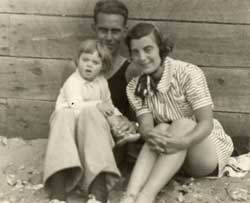 My mother, father and my sister, Janet, probably taken on Felixstowe beach in about 1934.
We lived in the last house on the road out of town. The nearest child of my age lived half a mile away, and he went away to boarding school and came back in the holidays a nervous wreck, unwanted and unloved. I was the apple of my parents’ eye, an unexpected (unplanned) pleasure who’d arrived over ten years after my sister, except they had to spend most of their time looking in other directions. I went to school at 3½, a kindergarten attached to the local primary school so that my mother could spend more time with my sister.
Compared with many Downs Syndrome people Janet was severely handicapped. She could only utter few words, but was certainly able to make us all understand her wishes. When I was born she was ten years old but had only just started to walk unaided. Even so she usually insisted that she should be pushed in my pram, and I was either carried or made to walk.
Once we moved to Braiswick I was mobile and independent. It was a safe place for a child, with very few cars passing by the front of the house, and in any case I could play in the huge garden and the surrounding fields.
Beyond our field at the bottom of the garden the Colchester golf course provided me with plenty of fun. Golfers were always losing their balls on our land, and I’d creep from the bushes to collect the ball and watch as the frustrated players thrashed around in the undergrowth. I could never understand the attraction of knocking a little white ball around that course, especially as the players never seemed to take any notice of the beautiful world around. They strode on under the colony of rooks that lived in the high pines on the other side of the field adjoining our house, ignored the magnificent trees and always left the horse mushrooms for me to collect.
 Every morning the rooks set off across our house to spend their days feeding in the fields. They always seemed to fly west at the start of the day, perhaps keeping the sun out of their eyes? At dusk they came back, spending a few minutes checking our grassland for tasty morsels before noisily settling down for the night.
Those rooks were a firm part of my life, providing a clear example of the social structure of these birds and allowing me to realise that animals are far wiser than we recognise.
One poor bird also gave me a severe lesson. I was given an air rifle, a very weakly sprung .177 gun that had no real power. That Spring I stalked through the fields taking pot-shots at anything that moved. Fortunately I seemed to miss most birds, and was always conscious of the waste of life if I did kill one of these creatures.
One day that feeling was fully confirmed. I spotted a young rook sitting on the branch of a tree bordering our field. I took a shot at the bird, it did not move. I loaded and shot again, and again, and again. The bird still did not move. It was very young and probably on its very first flight from its nest, which was just across the five-acre field. Slowly a gash opened up in its neck as I continued to fire pellets at the poor creature. By this time I was in tears, as the bird looked at me, unstaring, as I tried to finish it off. My memory of the final act in this gruesome event is now lost, but I’m sure that I finally left the bird to fend for itself.
It taught me a lesson about the futility of killing for the sake of doing so, and I have little respect for those who hunt with guns, particularly those ‘sportsmen’ who shoot at pheasants, or other game birds, who have probably never flown in their lives until forced into the air by the beaters. Most game birds stay on the ground, only flying into the trees at night to roost. Such sportsmen deserve a good thrashing. There’s nothing wrong in killing for food, provided the animal has been given a good life, but shooting hapless birds for pleasure defies logic.
Sunday, January 15, 2006
Braiswick
 The photograph is of my maternal grandmother, taken when she was just 18. Young ladies (if they exist at all) don't have the same grace and elegance these days, but they do have much more opportunity. My grandmother became a governess at Layer Marney Towers, near Tiptree, Essex.
We moved to Braiswick before the winter of 1947, which was very cold and brought heavy falls of snow. An early memory is of being pushed through a window to help clear snow away from the kitchen door, as we could not get out of the house. To a small mite (I was not yet three) the snow was very deep, and exciting. Hill Bend was a lovely house, a warren of rooms added in an ad-hoc fashion over several centuries. It stood in a large garden that stretched down the side of a hill towards an open field we shared with our neighbours. It was on one side of a valley and from the side gardens we could look across to the Daniels Brewery on the other side at the edge of the village of West Bergholt.
The garden dominated our lives in those days. It had thirty fruit trees, mostly apples, although there was a bullace, a Victoria plum, that rarely provided much fruit and a greengage that was extremely miserly. There were rows of black and red currants, raspberries, logan and gooseberries, and against the fruit shed was a glorious Morello cherry, whose fruit gave us the very best of pies. The garden had a large wooden barn, part coal shed, part garage and a smaller barn we used as a shed and fruit store, it was also the plucking room when we killed chickens. In the winter with a paraffin stove to keep us warm and a hissing Tilley lamp for light it was a cosy place, as we sat on boxes plucking feathers from still-warm chickens. The walls were lined with shelves, upon which were apples, each carefully wrapped in newspaper, each set to become part of my mother’s delicious pies.
Dad used to hand-dig about an acre of heavy clay every year to grow potatoes, partly to feed ourselves but also to add to the food we fed the pigs, chickens and rabbits. All were needed for food. A nightly chore was to boil up the mash for the pigs, throwing in whatever looked edible.
We took in young piglets, fattening them up for twenty or so weeks until they were sent to slaughter. One was returned, butchered; one half fresh the other half smoked or cured. For a few days there was a flurry of cooking and an excess of fresh pork. The remainder was salted and the cured pork hung in a larder where it would last until the next pig arrived.
In between the chickens gave eggs, and eventually themselves. Capons were kept for the winter season and rabbits were taken whenever they were ready. This may seem a basic way of life but we lived like lords compared to many families after the war, most of who had to rely upon supplies of poor quality rationed food from badly stocked shops.
That rationing system, which allocated precise quantities of food and clothing to every person in the country, continued until the 1950s, I still have my mother’s ration book, perhaps I can claim something from the unused coupons?
In our house we had apple pies, roast chickens and pots full of fresh vegetables throughout all those days, when most people were eking out the meagre rations allowed under the rationing system. My mother and father worked tirelessly to ensure that we had enough to eat, that we had proper clothing and kept warm.
Beyond those basic necessities of life we had very little, but not much more was needed. How many possessions do you really need? A woman told me yesterday that she ‘really needed a new bracelet’. She didn’t, she was just programmed to expect that she could have anything she wanted. That’s the price of commercialism, that’s the power of advertising. What’s sad is that governments now rely upon the tax gained from the sale of such trivia. There is another, much better, way of life, one that everyone in the whole could enjoy if we just took a step back and asked ourselves, ‘Do I really need this?’ Most of the time you can do without.
Saturday, January 14, 2006
My childhood was idyllic
 My childhood was idyllic. My world has rarely been better. There’s no easy explanation of loneliness. It is an unpleasantly painful yearning for contact with another person, an absence of any real feedback from anyone and wanting a friend but not really understanding what is a friend. My childhood was spent alone, but I don’t recall being lonely. That state of mind came much later in my life, and not because of the act of being alone, but through knowing that nobody really cared.
Childhood is a life filled with wonder and my world was wonderful. I was born at 239 Harwich Road, Colchester but we moved to 63 Braiswick, Colchester when I was somewhere between 2 and 3 years old, in part to find somewhere quiet for my sister, who had become the subject of ridicule by the local children, especially those who lived on the Council estate across the road.
I remember standing up at the Harwich Road house, grasping the leg of the piano and launching myself at the barley-twisted legs of the dining table. There was a ripple of applause as I reached my target and some time later I found myself in the garden, stumbling, and falling, down the pathway. We had visitors that day as I remember snatches of conversation and my father pointing out across to the fields that sloped away from our garden.
Today that land is covered with the infamous Greensted estate, tacky little houses that are a blot on the landscape and upon the psyche of those forced to live there.
Thankfully I have always been able to recall some episodes of my early life, so Alzheimer need not take all the credit, not yet.
I don’t remember the night of my birth, a time when Colchester was being bombed during the Second World War. Dr Cameron, our bluff Scottish doctor, had been attending my mother in a bedroom upstairs at Harwich Road. He shouted loudly at my father, telling him to bring a suitcase immediately. Dad feared the worst, believing that I had been stillborn and the case was needed for Dr Cameron to remove the corpse. That was not the real reason, as I was alive and well, and put into the case and then placed in a makeshift shelter under the dining table to obtain some protection from the bombs.
Those must have been frighteningly uncertain times, and it says much for the stoicism of the human race that we can withstand all sorts of pressures before we finally succumb. The European wars of the last century were dreadful examples of man’s intractable attitude and desire for power and control.
My father was in a reserved occupation, making ships boilers and other equipment rather than donning a khaki uniform and marching off to the front. I can’t place myself in his position but it has always seemed to me that he was in the right place, using his skills to help his country, while looking after his wife and child. That said he later had a growth in his lung, very likely caused by over-zealous use of asbestos or working with lead in the factory where he assembled the boilers.
Before me came Janet, my sister. Born 17 November 1933 she had Downs Syndrome. In my childhood she was mentally handicapped, today she would probably have learning difficulties. Whatever she had a profound affect upon my life, and there will be more about her as this tale progresses.
Friday, January 13, 2006
Children Who Never Grow Up

“We’ve got loads of daisies in the front garden,” Mum said. “We can use those.”
“What do you mean?” said my Dad, “How will they help.”
Mum was right, but then she always was, there were hundreds of Michaelmas daisies in the front garden. No idea why they had suddenly appeared, because I’d never noticed them before, but at ten years of age do you notice something like daisies? I knew there was some of Mum’s apple pie in the fridge, and that I was running short of cigarette cards, all because that John, the boy down the road had cheated, I was never going to play ‘flicksie’ with him again. I didn’t notice that there was homework to do, or that there was dirt behind my ears. All that was for others, Mum in particular.
“Well, we could use those. Make a framework, there’s some netting in the shed, that’ll do it. You make a start on that and I’ll do some signs.”
Dad looked at me, and laughed, “Come on son, we’d better do as she says, or there’ll never be any peace.”
Out in the shed Dad sorted out suitable lengths of timber, and we measured and sawed, banged in nails and spread out netting. Soon the wooden frame was covered with netting and I was sent to the front garden, pushing our biggest wheelbarrow and a pair of scissors, to start cutting the daisies.
Do you remember what it was like as a child? It was all very exciting to start with, as I cut and plundered my way through the huge patch of daisies that had spread themselves along the front drive of our house. That was exciting, and it stayed that way as I took the first barrow load back to Dad, who had by then fixed the frame in place, and all was well as we weaved the stalks of the daisies into the netting so that it was all covered. Not a strand of netting could be seen, but the front garden looked very bare.
This was a big frame, and can you even imagine how many daisies I cut, carried and wove? There were hundreds, thousands perhaps, even millions in boy-speak, and while we worked it was getting hotter, and we were running out of time, and I kept remembering the homemade lemonade, and that slice of apple pie in the fridge.
Eventually all was finished, and Mum appeared with two huge signs, which Dad nailed on to each side of the frame. On top of it all she mounted a big cut-out of Peter Pan.
The signs read, ‘For the Children Who Will Never Grow Up’, my Dad was Chairman of the Local Society for Mentally Handicapped Children, and that’s the way I still feel today, knowing that I’ll never truly grow up, remembering how Dad and me crept under the netting and into the car and set off in our float for the local carnival.
Thursday, January 12, 2006
Yorkshire Roots
My family come from Yorkshire. There’s still a place up there that’s named after us, just a minor forest, nothing too grand and indeed you’ll be hard-pressed to find a tree there these days but that’s another story. It’s now part of Huddersfield, a small suburb that can be passed through without comment.
The rot set in about 1215. One of my relatives ran off with the local Sheriff’s daughter. It was a real love match, well John Lockwood was besotted but that’s the way it is in my family. She seemed willing enough at first but that changed after a while (and I’ve heard of that as well). All this seems so familiar; clearly it’s all in the genes. A Lockwood male falls in love, runs away with his dream, and seems set upon a life of domestic bliss. Given time the woman shows just how fickle she can be, and the union tends to fall apart.
It’s happened so many times it’s a wonder the male Lockwood line still exists. As I write this particular Lockwood line is in serious danger of decline, as son shows no sign of wishing to procreate. Stop to think about that for a while and you will realise that Darwin got it all wrong.
It’s not survival of the fittest, but rather the weak and devious ones who manage to procreate. That’s one reason why there are not so many Lockwood’s around. Fortune does not favour the brave.
Think of John Lockwood with his common wife swept away by desire, closely followed by the irate father and his posse of submissive villains. This was surely one of the greatest love stories of all time. The Sheriff’s daughter had given up so much to be with her John, but probably he had seemed a better catch than that vagabond of Sherwood Forest. After all John’s family owned the woods, they didn’t just live in them nor were they vassal to any man, least of all Sheriff Hudder. John managed to evade the Sheriff for many months, so enough time passed to ensure that another little Lockwood was brought into the world. But John’s luck finally ran out.
We are not sure how they were discovered but found they were. John decided to fight for his love. He was not going to allow a wicked father to wrest away his beloved. A fight began that lasted for hours. Slowly John broke down the opposition, picking off the posse one by one with the skilful use of his long bow. All the time he was urging his lovely lady to stay behind him to guard over their lovely new son and heir.
At last the Sheriff came into view. John shouted aloud, glad at last that the fight was about to come to reach its climax. Slowly he pulled back the shaft of the arrow in his bow, taking careful aim. This was one shot that must hit its target. By removing this curse he would be able to enjoy the rest of his life with the family he loved.
Just as he was about to loose the arrow his lovely woman crept up behind him and cut the string of his bow! John soon saw the significance of her treacherous act. It’s one that has been repeated many times since by Lockwood women, and probably had been the curse of many of John’s forebears. Unlike lesser men he wasted no time upon retribution but instead thought of the future. Clasping his fragile child to his breast he prepared to flee, but that is not the way of any Lockwood. He could not resist one last shout at the arrogant figure who was even then drawing back his own bow preparing to fire at John.
John turned, an abusive phrase on his lips as the arrow struck him in the chest. It passed through his precious baby on its way to his pounding heart. Both father and son fell to the ground, dead.
After that the Lockwood family could no longer live beside the slayer of their bloodline. The Sheriff claimed the field where John was slain as his own. It is there still today, Huddersfield, now grown fat upon the riches of its close neighbour, Lockwood.
My family just wanted to get away, anywhere. Gathering together what they could carry they moved south and after several weeks found themselves in the hallowed lands known as Suffolk. Skilled weavers they were seized upon by the Huguenots (eventually) and found a comfortable living serving the gentry of the county. They found Suffolk a land of contrast. There were rich landowners and poor peasants, little of a middle class. For many centuries Lockwoods were found sprinkled over the county as Ag labs, poor but willing workers on the land with no history or glory. Serious historians may ignore most of this story, accepting that it is little more than embellished truth, yet John of Lockwoode did run off with the Sheriff’s daughter, and son and man were killed by that dastardly coward.
You may assume that the bloodline that ran through that hero of our time in 1215 or thereabouts now runs very thin today.
The rot set in about 1215. One of my relatives ran off with the local Sheriff’s daughter. It was a real love match, well John Lockwood was besotted but that’s the way it is in my family. She seemed willing enough at first but that changed after a while (and I’ve heard of that as well). All this seems so familiar; clearly it’s all in the genes. A Lockwood male falls in love, runs away with his dream, and seems set upon a life of domestic bliss. Given time the woman shows just how fickle she can be, and the union tends to fall apart.
It’s happened so many times it’s a wonder the male Lockwood line still exists. As I write this particular Lockwood line is in serious danger of decline, as son shows no sign of wishing to procreate. Stop to think about that for a while and you will realise that Darwin got it all wrong.
It’s not survival of the fittest, but rather the weak and devious ones who manage to procreate. That’s one reason why there are not so many Lockwood’s around. Fortune does not favour the brave.
Think of John Lockwood with his common wife swept away by desire, closely followed by the irate father and his posse of submissive villains. This was surely one of the greatest love stories of all time. The Sheriff’s daughter had given up so much to be with her John, but probably he had seemed a better catch than that vagabond of Sherwood Forest. After all John’s family owned the woods, they didn’t just live in them nor were they vassal to any man, least of all Sheriff Hudder. John managed to evade the Sheriff for many months, so enough time passed to ensure that another little Lockwood was brought into the world. But John’s luck finally ran out.
We are not sure how they were discovered but found they were. John decided to fight for his love. He was not going to allow a wicked father to wrest away his beloved. A fight began that lasted for hours. Slowly John broke down the opposition, picking off the posse one by one with the skilful use of his long bow. All the time he was urging his lovely lady to stay behind him to guard over their lovely new son and heir.
At last the Sheriff came into view. John shouted aloud, glad at last that the fight was about to come to reach its climax. Slowly he pulled back the shaft of the arrow in his bow, taking careful aim. This was one shot that must hit its target. By removing this curse he would be able to enjoy the rest of his life with the family he loved.
Just as he was about to loose the arrow his lovely woman crept up behind him and cut the string of his bow! John soon saw the significance of her treacherous act. It’s one that has been repeated many times since by Lockwood women, and probably had been the curse of many of John’s forebears. Unlike lesser men he wasted no time upon retribution but instead thought of the future. Clasping his fragile child to his breast he prepared to flee, but that is not the way of any Lockwood. He could not resist one last shout at the arrogant figure who was even then drawing back his own bow preparing to fire at John.
John turned, an abusive phrase on his lips as the arrow struck him in the chest. It passed through his precious baby on its way to his pounding heart. Both father and son fell to the ground, dead.
After that the Lockwood family could no longer live beside the slayer of their bloodline. The Sheriff claimed the field where John was slain as his own. It is there still today, Huddersfield, now grown fat upon the riches of its close neighbour, Lockwood.
My family just wanted to get away, anywhere. Gathering together what they could carry they moved south and after several weeks found themselves in the hallowed lands known as Suffolk. Skilled weavers they were seized upon by the Huguenots (eventually) and found a comfortable living serving the gentry of the county. They found Suffolk a land of contrast. There were rich landowners and poor peasants, little of a middle class. For many centuries Lockwoods were found sprinkled over the county as Ag labs, poor but willing workers on the land with no history or glory. Serious historians may ignore most of this story, accepting that it is little more than embellished truth, yet John of Lockwoode did run off with the Sheriff’s daughter, and son and man were killed by that dastardly coward.
You may assume that the bloodline that ran through that hero of our time in 1215 or thereabouts now runs very thin today.
Wednesday, January 11, 2006
Heaven on Earth
- Heaven on Earth
That idea came, unsolicited, during National Friendship Week (which I presume to be restricted to the United States of America, that country that murders well over 30,000 of its own citizens every year by shooting them with a gun).
Just over half, 52% would be female, leaving 48% males. Racially 70% would be non-Caucasian, 30% would be white (Caucasian). The same proportion would be labelled Christian, just 30%, but whether those people just carry that label or are active believers is questionable.
Surprisingly 89% would be heterosexual, meaning that 11% were not. That is difficult for someone of my ancient years to properly comprehend. During my formative years I didn’t have any contact with homosexuals. That’s difficult to understand these days, and even more perplexing as my first job was in a hospital for the mentally ill. This place contained about 5,000 people; 3,000 patients, 2,000 staff. We were a tolerant bunch, that’s one of the joys of mental instability, it allows for alternative perspectives. Yet, in that whole place I knew but three practising homosexuals. They were great blokes, life and soul of the party, and very openly homosexual. Undoubtedly there were more in that hospital, covert creatures unwilling to expose themselves but even so the present statistic of about one in ten of the adult population as homosexual is difficult to accept.
It’s not that there is anything particularly objectionable about homosexuality. It does not offer me any great appeal, although I will admit to having let one of the male nurses try it on one evening, and that it did come as something of a relief to find that I was not in the least interested in his persuasions. Male homosexuality does have some unpleasant attributes, but they are a pleasant bunch, very often making better friends than heterosexual acquaintances.
I once had a wife who turned to lesbianism at one stage in her life, post me. Not that she is a reliable indicator of the progress of female-kind as for a time she was apt to jump upon any passing fad, not that she should be unduly blamed for that, we were both searching for something, we knew not what. Reality now suggests that we were really looking for each other, but that’s another story.
Feminism started her fall from the divine, partly because that led to her sharing favours with anyone who happened to be passing, in a search for her independence from the yoke of marriage. Perhaps it is wrong to blame the feminist cause for her diversions, but there is a link. She wanted to find herself, feeling that being described as ‘the wife’ was demeaning, and who could disagree? From that state of mind it was an easy step to sexual freedom. Not everyone saw it that way, myself included. There will be more later of the woman I adored, for now just accept my bitter cynicism.
Of our population, just 6% would possess 59% of the entire world's wealth and most would be Americans, although that is slowly changing. That’s a ridiculous situation, even if material wealth is regarded as of little consequence. Relate that wealth to the odious fact that 25% of all pollution comes from the North American continent and someone needs to start thinking. Not least Americans because they are living in an unstable world. China is increasing its hold upon world economics and the future for USA does not look attractive.
Four-fifths (80%) of the world lives in substandard housing, and that does not mean that they just lack a dishwasher, or two bathrooms. This statistic can be expanded, as housing is a valuable indicator. Alongside the poor housing will be found bad or no water supply, no reliable electricity or sanitation, insufficient schooling and a base quality of life.
Half the world does not have enough to eat. It’s not just that these people cannot afford a MacDonald’s burger (lucky people in that at least) but they have so little food they suffer from malnutrition, with attendant consequences of high infant mortality, increased risk from crippling diseases and short life span. Think about that unseen partner of yours, the other person who shares this world with you, as you tuck into a hearty meal, or consider buying some new toy; a new car, an overseas holiday or an even larger home. Your mate is dying of starvation.
It will not be easy to tell most of the poor people how badly off they are compared with us, as over 70% of the world cannot read. That’s a comfortable feeling for us, as what the poor don’t know about they will not miss. Except that the Internet is opening up our world to even these people. Some Indian villages have Internet access, admittedly through sites that are specially created for them – as they have not been taught to read or write, but the future is there. One day everyone will know what is available; the trick will be in ensuring that they can get what they want. If they are deprived the fragile world we have created for ourselves is in danger of being over-turned. The old hags sitting at the foot of the guillotine, quietly knitting as aristocratic heads toppled to the sawdust will easily be matched.
Just one child in our hundred would have a college education, and by that I mean an American college, meaning that they went to school until after their eighteenth birthday.
A million people will die this week. For over 500 million of the earth’s people death often comes as a release from the dangers of war, or the loneliness of imprisonment or the agony of torture. You can probably attend a church meeting without fear of harassment, arrest, torture, or death. Yet more than three billion people in the world don’t have that luxury. Church leaders should reflect upon such repression, and ease up on implied guilt.
Most of us have food, clothing, a roof over our head and a place to sleep. Most of the world is not so privileged as they have no money in the bank or even in a wallet. Spare change is a luxury that less than one in twelve of us ever enjoy.
Old adages state; what goes around comes around, work like you don't need the money, love like you've never been hurt, dance and sing as if nobody's watching or listening. Live as if it is Heaven on Earth. Believe it as you read this, in comparison you are in heaven already.
Tuesday, January 10, 2006
So Far
Shall I live alone when I grow old?
Sat in an armchair as I scowl in the cold
At a world changed beyond recognition
And yearn for days when I was bright and alert
And the pain in my heart did not hurt?
I’ll panic and moan as I sit on the throne
Picking at scabs of the cuts, wishing I’d had the guts
To let the world love and not drone
On about the times I have known
That now seem to have flown
Or will a new world bring purpose and zest
Not knowing what to choose for the best
As old bones rush through on a crest
Full of magical games to play?
I’ll have some of that if I may
There’ll be time for cooked breakfast every day
Not having to care what I weigh
Plenty of time to waste
Thinking of jobs not to my taste
No worry about being replaced
Reading books that will teach me to play
New games that lead grandchildren astray
We shall skip to the beach
Just as mum starts to preach
We’ll laugh as we scamper away
Time for childhood again
Perhaps I’ll jump on a plane
To lands faraway on a dream
There I’ll listen to voices
That tell me of choices
‘When I grow old I shall wear Purple’ by Jenny Joseph, is a well-known poem that I used as the inspiration for my own version.
It’s not easy to start a Blog about yourself, but the time is ripe, and so, increasingly, am I. The title is So Far because that’s the way it is: I’ve come So Far so far. There may be some way yet to go. Whatever the real reasons this is a chance to capture a few moments in my life that will, one day, give my grandchildren some idea of what I once was.
Over the years I’ve helped many people produce their own stories. Usually they have been factual accounts: I was born, I did this, and now I’m waiting to die. There’s a chance that this story will not be like that, it may follow the tradition of the essayist, a creature I’ve always admired. We don’t spend enough of our lives reflecting upon our lives, but hopefully in some places I will do just that, have a glancing look at the world we have created, and make some comment upon it. This is not a gospel text, it will not provide answers, nor is it intended to create a pathway that you can follow. After all, my life has not been one that anyone would wish to copy or revere. It’s been a struggle, but I’ve suffered nothing like the hardships faced by most of the world. This is a hard life for too many people, and it appears that we have lost our way.
Sat in an armchair as I scowl in the cold
At a world changed beyond recognition
And yearn for days when I was bright and alert
And the pain in my heart did not hurt?
I’ll panic and moan as I sit on the throne
Picking at scabs of the cuts, wishing I’d had the guts
To let the world love and not drone
On about the times I have known
That now seem to have flown
Or will a new world bring purpose and zest
Not knowing what to choose for the best
As old bones rush through on a crest
Full of magical games to play?
I’ll have some of that if I may
There’ll be time for cooked breakfast every day
Not having to care what I weigh
Plenty of time to waste
Thinking of jobs not to my taste
No worry about being replaced
Reading books that will teach me to play
New games that lead grandchildren astray
We shall skip to the beach
Just as mum starts to preach
We’ll laugh as we scamper away
Time for childhood again
Perhaps I’ll jump on a plane
To lands faraway on a dream
There I’ll listen to voices
That tell me of choices
‘When I grow old I shall wear Purple’ by Jenny Joseph, is a well-known poem that I used as the inspiration for my own version.
It’s not easy to start a Blog about yourself, but the time is ripe, and so, increasingly, am I. The title is So Far because that’s the way it is: I’ve come So Far so far. There may be some way yet to go. Whatever the real reasons this is a chance to capture a few moments in my life that will, one day, give my grandchildren some idea of what I once was.
Over the years I’ve helped many people produce their own stories. Usually they have been factual accounts: I was born, I did this, and now I’m waiting to die. There’s a chance that this story will not be like that, it may follow the tradition of the essayist, a creature I’ve always admired. We don’t spend enough of our lives reflecting upon our lives, but hopefully in some places I will do just that, have a glancing look at the world we have created, and make some comment upon it. This is not a gospel text, it will not provide answers, nor is it intended to create a pathway that you can follow. After all, my life has not been one that anyone would wish to copy or revere. It’s been a struggle, but I’ve suffered nothing like the hardships faced by most of the world. This is a hard life for too many people, and it appears that we have lost our way.
Monday, January 09, 2006
Computers
Started to search through some of my old files – with the intention of writing something of a biography. Of course that had to wait until I’d dealt with the post, answered the most important emails, rebooted the computer because it had an itch somewhere in its nether regions and had decided to go very slowly.
Have you ever wondered why we are acting as nannies for this bits of silica? They’ll take over in the end, but for now seem content to let us batter ourselves into eternity frustrating over idiosyncrasies that are no more than the learning curve of any small child. And that’s what the computer in front of you is, and mark my words it will grow up one day and look at you and say, ‘get out of my life you boring old fool, what do you know about anything?’
The truth is – we know nothing.
All that prompted me to write a little ditty;
It's not my mess this life
When we do as others ask
Time flies
The morning breaks nights still
Promising a wondrous day
How shall that be filled?
With the mundane of existence
Selling my soul for another's tuppenny demand
Push aside the piles of other people's dreams
Find space to write sparse words
Not in anguish or pain but to explain
Desire
Time shadows the need to express
For days to watch the grass grow
To hear birds chattering delight as
Walking with my misty outline
The world knows which way to go round
That poem is not just about computers – it’s about you lot out there – whoever you are. Whatever, I still love you.
Have you ever wondered why we are acting as nannies for this bits of silica? They’ll take over in the end, but for now seem content to let us batter ourselves into eternity frustrating over idiosyncrasies that are no more than the learning curve of any small child. And that’s what the computer in front of you is, and mark my words it will grow up one day and look at you and say, ‘get out of my life you boring old fool, what do you know about anything?’
The truth is – we know nothing.
All that prompted me to write a little ditty;
It's not my mess this life
When we do as others ask
Time flies
The morning breaks nights still
Promising a wondrous day
How shall that be filled?
With the mundane of existence
Selling my soul for another's tuppenny demand
Push aside the piles of other people's dreams
Find space to write sparse words
Not in anguish or pain but to explain
Desire
Time shadows the need to express
For days to watch the grass grow
To hear birds chattering delight as
Walking with my misty outline
The world knows which way to go round
That poem is not just about computers – it’s about you lot out there – whoever you are. Whatever, I still love you.
Saturday, January 07, 2006
Writing on Demand
Writing on Demand
200 words she said, by today.
What do you say, but OK?
Then came that moment of panic,
the phone started to ring,
I knew who it was, and No,
I hadn't even started to do
THAT job yet . . .
and I had to get a new doorknob for the bathroom door -
No, no, no, don't go there, but it could be fun.
I needed a pee,
desperately
but decided that would set the deadline for me.
I'd write until I couldn't hold on any longer . . .
(besides the bathroom door would only swing open at the wrong moment.)
That had me thinking about
Jenny
She danced and sang as my Teddy Bear,
said 'You are my Sunshine' from the lights of the stage
Soubrette made dreams
an acrobatic blonde dancing on my tender heart
in Skegness took my virginity without mention.
Too much of this world she knew
yet she sought not the sailor's game.
Was just a child of the 60's
doing what we all did then
'Where is the Love' was to blame.
The child that became
has now a much better name
than those that fumbled together in her creation.
Genteel and wed
to a producer of plays
closely watched by her lonely mother.
Happiness is always tinged with sadness, isn't it? Must get a new knob, after I've had that pee.
© Trevor Lockwood 2006
200 words she said, by today.
What do you say, but OK?
Then came that moment of panic,
the phone started to ring,
I knew who it was, and No,
I hadn't even started to do
THAT job yet . . .
and I had to get a new doorknob for the bathroom door -
No, no, no, don't go there, but it could be fun.
I needed a pee,
desperately
but decided that would set the deadline for me.
I'd write until I couldn't hold on any longer . . .
(besides the bathroom door would only swing open at the wrong moment.)
That had me thinking about
Jenny
She danced and sang as my Teddy Bear,
said 'You are my Sunshine' from the lights of the stage
Soubrette made dreams
an acrobatic blonde dancing on my tender heart
in Skegness took my virginity without mention.
Too much of this world she knew
yet she sought not the sailor's game.
Was just a child of the 60's
doing what we all did then
'Where is the Love' was to blame.
The child that became
has now a much better name
than those that fumbled together in her creation.
Genteel and wed
to a producer of plays
closely watched by her lonely mother.
Happiness is always tinged with sadness, isn't it? Must get a new knob, after I've had that pee.
© Trevor Lockwood 2006
Wednesday, December 28, 2005
Choice
There's a comment that suggests that Public Choice Theory might be interesting to consider. That's a challenge for an LSE graduate, as public choice in a democracy presents a minefield, peopled by ignorance and chronic self-interest.
Just occasionally the public (whoever they may be) become so stretched and disenchanted by those in government that they rebel, or at least protest. This is often seen as little more than self-interest, and such cynicism presently holds sway, which is unfortunate.
At times there may be those who do consider the wider picture, perhaps even the public good, and who may have no other interest.
With Bloor Homes we have a clear statement of intent. They want to make a profit. They have found a willing partner, Suffolk Coastal District Council, who have land (held in trust for the people) and a deal of embarrassment.
Suffolk Coastal District Council's reasoning is less clear. Eighteen years ago they bought the Herman de Stern building, for just £50,000. Anyone would have done the same. It was abargain. A huge house, in good condition, beside the sea, with excellent transport links and a pleasant town within walking distance. Beside this fine house stood car-parking and about 600 beach huts, much-loved and well-used. It was an area full of 'happy families'.
The Council threw the beach huts off the land, creating a loss of £5.5 million in rental income, and much more in tourist spend in the area.
They threw out the tenants of the fine house, and rejected all plans to develop the house.
The day after the developer went public with their plans the building burnt down.
Cynical?
How can anyone be critical of such a council? They have clearly acted in the public good. Haven't they?
Now they want to give the land away, and to knock down the fine building, even though it is insured for £950,000 - not a bad capital gain on the original investment. Pity it is now all to be lost.
Not much public good to be found: lost rental income spread over 18 years, loss of a publicly owned building, loss of publicly owned land to a private developer in the hope (vainglorious) that profit will be shared.
That's excellent because 'public good' does imply that is hard or even impossible to produce for private profit, because the market fails to account for its large beneficial externalities.
By definition, a public good possesses two properties:
It is non-rivalrous, in that its benefits fail to exhibit consumption scarcity; once it has been produced, everyone can benefit from it without diminishing other's enjoyment.
It is also non-excludable, in that, once it has been created, it is very difficult, if not impossible, to prevent access.
Public goods possess these properties absolutely and is for society as a whole, we call these 'the public' not Bloor Homes Ltd. Can someone explain the distinction to Suffolk Coastal District Council?
Just occasionally the public (whoever they may be) become so stretched and disenchanted by those in government that they rebel, or at least protest. This is often seen as little more than self-interest, and such cynicism presently holds sway, which is unfortunate.
At times there may be those who do consider the wider picture, perhaps even the public good, and who may have no other interest.
With Bloor Homes we have a clear statement of intent. They want to make a profit. They have found a willing partner, Suffolk Coastal District Council, who have land (held in trust for the people) and a deal of embarrassment.
Suffolk Coastal District Council's reasoning is less clear. Eighteen years ago they bought the Herman de Stern building, for just £50,000. Anyone would have done the same. It was abargain. A huge house, in good condition, beside the sea, with excellent transport links and a pleasant town within walking distance. Beside this fine house stood car-parking and about 600 beach huts, much-loved and well-used. It was an area full of 'happy families'.
The Council threw the beach huts off the land, creating a loss of £5.5 million in rental income, and much more in tourist spend in the area.
They threw out the tenants of the fine house, and rejected all plans to develop the house.
The day after the developer went public with their plans the building burnt down.
Cynical?
How can anyone be critical of such a council? They have clearly acted in the public good. Haven't they?
Now they want to give the land away, and to knock down the fine building, even though it is insured for £950,000 - not a bad capital gain on the original investment. Pity it is now all to be lost.
Not much public good to be found: lost rental income spread over 18 years, loss of a publicly owned building, loss of publicly owned land to a private developer in the hope (vainglorious) that profit will be shared.
That's excellent because 'public good' does imply that is hard or even impossible to produce for private profit, because the market fails to account for its large beneficial externalities.
By definition, a public good possesses two properties:
It is non-rivalrous, in that its benefits fail to exhibit consumption scarcity; once it has been produced, everyone can benefit from it without diminishing other's enjoyment.
It is also non-excludable, in that, once it has been created, it is very difficult, if not impossible, to prevent access.
Public goods possess these properties absolutely and is for society as a whole, we call these 'the public' not Bloor Homes Ltd. Can someone explain the distinction to Suffolk Coastal District Council?
Friday, December 23, 2005
Latest correspondence
Here's some of the latest emails between me and Suffolk Coastal District Council about the development by Bloor Homes of the seafront at Felixstowe, Suffolk. The latest comes first.
Dear Mr Ridley
I thank you for your prompt reply.
In your response to question 2 you state that part of the site is greenfield, part brownfield. Can a plan for these be supplied - as far as I am aware only the small part around the Martello Tower can ever have been considered brownfield, together with Herman de Stern land, although that is only a few square feet (167x250 from memory)?
Both of these brownfield portions are areas that should not be part of the development, the Herman should be rebuilt and as Colonel Lemon has pointed out the Martello Tower surrounds have a significant military history that should be preserved.
Remove those contentious areas from the parcel and what remains is all greenfield.
I note from your reply that this development is dependent upon DEFRA funding for the coastal defences.
May I wish you a relaxing holiday.
Trevor Lockwood
Philip Ridley wrote:
I have received copies of e-mails from you (and their replies) from the Leader of the Council, Ray Herring and via the South Area Development Control Officer, Paul Coffey. I have been sent them as there a number of planning issues upon which you require further clarification.
Q1- Please confirm that the planning consent granted to Bloor Homes departs from the District Plan in several distinct and important respects?
The application was considered to be a Departure from the development plan and was therefore advertised as such on site and in the press as is required by the regulations.
The Report that was recently presented to the South Area Development Control Sub Cttee clearly explains why the application was considered to be a departure. The Report can be viewed on the Council's website- the Minutes of the meeting are now available- please press the Your Council icon and follow the links through.
As a departure application , where the Council is a major landowner the application must be referred to the ODPM who has the opportunity to "Call In " the application for determination by himself.
Q2 Will you confirm that this site is a greenfield site?
PPG3 defines "brownfield" or "previously developed land" as "that which is or was occupied by a permanent structure... and associated fixed surface infrastructure. The definition covers the curtilage of the development..."
In my view , some parts of the site are brownfield and some parts are greenfield.
If you wish to view PPG3 it can be found on the odpm's website www.odpm.gov.uk/planning
Q6 Will you explain why the developer has been granted 5 years to complete this project, why was it extended beyond the normal 3 years?
The Planning and Compensation Act 2004 amended S91 of the T and CP Act 1990 by reducing the normal duration of planning permissions from 5 years to 3. However , the section allows the duration to be "such other period (whether longer or shorter) beginning with that date as the authority...may direct"
The Circular (08/2005) which accompanies the new act suggests that "the timescale should be appropriate to the size and nature of the development or works"
I considered that in this case it was one which justified a longer period. The reason for this recommendation included the following:-
It is a major development where a large number of detailed working drawings will need to be prepared
Conditions on the planning permission are likely to require a large number of details to be submitted before commencement of the development
The DEFRA announcement on funding for the coastal defence works may well mean that commencement of the development has to be delayed until funding for those works is assured.
Thanks
Philip Ridley
Head of Planning Services
From me: Mr Herring
Please note that I am sending this email to a number of interested parties, as a result I have left your reply to me so that both sides can be examined.
I am grateful for the care and consideration that you have taken in replying to my questions. It is extremely important that such information is freely available, and for the first time some of the reasoning behind your support for this housing development has become clear.
Unfortunately that's not to suggest that they are reasonable or well-considered.
1. It's right that this is now noted as a departure from the District Plan, that major fact has been omitted from any public discussion so far.
I trust now that GOEast will take more time to properly consider the application, as I understand that their time for review can be extended. This land is so important to the town of Felixstowe that proper consideration is required.
2. The £2.46 million that Bloor Homes are said to be providing needs extremely careful costing and examination, and the allocation of £100,000 is a paltry sum when the long-term costs of maintaining this amenity land are considered.
The amenity provision of the scheme is of extremely doubtful benefit to the town, consisting of a few wooden toys, likely to be vandalised, a reduction of the available car parking and the revamping of a toilet block. The landscaping is unlikely to survive the ravages of constant public usage as the species selected are maritime plants, not used to grazing or trampling.
The town does need amenities. A skateboard park in this location would be ideal. I understand that such a park in Calais, France has been widely acclaimed.
The amenity should not be provided by this developer, no substantive gain will accrue as a result, and costs of other elements of the design may well be agglomerated as a result. Far better that the developer pays the market price for the land, and SCDC, after proper consultation with townsfolk uses that money to provide needed facilities, not the poor scheme presently proposed.
3. Noted. I await that report with interest. It may be noted that a barrister seems a strange advisor for an amenity provision project.
4. I find the following statement inexplicable: The particular circumstances that remain applicable to this development, namely the overall economic considerations and the purpose of the residential element, i.e. to enable leisure development to take place, justify this proportion. Any increase in the number of affordable units would be likely to result in a consequential increase in the overall number of units on the site.
The housing density of this project is already greater than that recommended by Mr Prescott for inner-city developments. How will you add more? The government recommendation is for 30% affordable housing in private housing projects, let alone projects on land publicly owned. You still fail to answer my question: what is the housing need in Felixstowe?
5. By every definition of which I am aware this is a Greenfield site. It has never previously been developed. I await Head of Planning's definition with interest.
6. That decision is also awaited.
7. The use of the Martello Tower must include the previous military use, of which that four acres is a part. The semi-circular residential arc will be 10 metres high, yet only 4-5 metres away from the Martello Tower, itself nearly 10 metres high. Parts of the housing development will never see the sun.
8. A decision to demolish the Herman has obviously been made, yet that may not be the best solution. One of your own councillors, Doreen Savage, has pointed to the need for a small theatre in the town. Plans have already been drawn to use the Herman as a theatre, and restoration of an existing building is often easier and cheaper than new build.
The excuse given for refusing professionals access to the site is weak and not worthy of further comment.
9. Given the choice between education provision and the unwanted leisure scheme proposed I suggest that hardly anyone in Felixstowe will back your proposal. If the land is sold to Bloor Homes then the Education Department should have first call upon those funds. What is more important? The education of our future generations or the profit to be made by Bloor Homes? I have conservatively estimated that this development will make, at least, £20 million profit for Bloor Homes. So far nobody has contested that figure.
You are saying that the residents of Felixstowe must pay for the education of the new occupants of this development so that the developer can walk away with our land and our money. Where's the 'best-value' in that?
10. You talk of a self-financing barter arrangement. I call that a fudge. If this scheme is so attractive to the town why not obtain estimates (preferably from local contractors) to underatke the leisure facilities envisaged? Put the barter advantage to the test. At the same time present the economic case for selling this land for residential development. How much would Bloor Homes expect to pay for similar land, with sea views, good transport links, schools and jobs nearby, with easy access to a thriving town? How much money will we then make?
Barter only works if the contract is between equal partners. You have already shown extremely weak bargaining skills in allowing yourself to be placed in this position.
There is still time to withdraw. The town will thank you for it. Put the skateboard on the land, landscape and improve with 700 car parking spaces (the number there at present) and allow the beach huts to return and the amenity value of this area will soar, at minimal cost, and without this boringly uninspired Cell Block South development.
Trevor Lockwood
Ray Herring wrote:
Mr Lockwood
I have pulled a few strings for you and please find below my response to your email of the 17th December.
1. . “the planning consent granted to Bloor Homes departs from the District Plan in several distinct and important respects?”. The matter of the planning processes adopted by the Council and used by the regulatory South Area Development Control Sub-Committee is something that should be taken up with the Head of Planning Services. I have passed your enquiry to him. I should be grateful if you would note that the planning processes used to determine the planning application are outwith the control of the applicant (J S Bloor [Sudbury] Ltd) and, furthermore, the Cabinet Councillors played no part in the determination process. However, I note that the Report made to the Development Control Sub-Committee by the Head of Planning Services included the comment “On registration of the application it was considered that the application did not accord with the provisions of the Development Plan and it was advertised on site and in the press as a “departure” application.”
2. “Has the developer given any money for maintenance?” The leisure development is enabled by the residential development. The housing will enable the creation of leisure development, car parks and services. J S Bloor will be funding the cost of developing the public facilities (£2,466,000). The Bloor commitment will include provision for a future maintenance fund. The initial financial element to this fund will be at least £100,000 (see the minutes of the Cabinet meeting held on 19 July 2005).
3. “Some months ago you said that a senior barrister had examined the contract and confirmed that it gave good value. Can I see a copy of that barrister's report to SCDC?” This is taken to be a formal request under the Freedom of Information Act. It will be answered within the statutory 20 working days of the submission of the request (taken to be the 17 December 2005 date of your initial email).
4. “How does the 10% allocation [of affordable housing] match the present housing demands in the area?” The 16 affordable housing dwellings included are designed as an integral part of the scheme, indistinguishable from the remainder of the dwellings. They represent 10% of the residential development. Planning Policy AP38 does not specify the proportion of affordable houses that should be provided. The particular circumstances that remain applicable to this development, namely the overall economic considerations and the purpose of the residential element, i.e. to enable leisure development to take place, justify this proportion. Any increase in the number of affordable units would be likely to result in a consequential increase in the overall number of units on the site. In any event, 65% of the units on the scheme are 2 bedroom units which may well appeal to first time buyers.
5. “Will you confirm that this is a greenfield site?” This is a matter that should be referred to the Head of Planning Services. I have passed your enquiry to him. However, I take the view that, as the site has been used in the past for a variety of purposes, and that certain parts of it continue to be used on a temporary basis, this is clearly a re-development. Therefore I believe that it cannot be described as “Greenfield” i.e. previously undeveloped.
6. “Will you explain why the developer has been granted five years to complete this project, why was it extended beyond the normal three years?” This is a matter that you should take up with the Head of Planning Services. I have passed your enquiry to him.
7. “At no point has any consideration been given to the historical importance of this site, particularly to the four acre area around the Martello Tower. English Heritage have asked you to consider this matter, but it has been ignored. Can you explain why no answer has ever been given to Felixstowe residents?” In accordance with Planning Policy the development is focused on the Martello Tower. The design concept of the residential development around the tower is that of a semi-circular terrace. This is considered to best reflect the form and character of the Tower and draw attention to it in a way that a square or grid-iron pattern could not.
Throughout the current project to date both the Council and Bloor have endeavoured to maintain ongoing and active liaison, contact and consultation with the various officers of English Heritage. Officers have carefully explained to English Heritage that the proposed development represents the most positive options for the facilitation of expenditure to secure the future good condition and positive use of the tower. The District Council has commissioned a characterisation study (of the South Seafront Land which reflects the setting of the Martello Tower), together with a preferred use study, and a condition survey - all as recommended by English Heritage.
Bloors has sought (and obtained) separate approval for the removal of the garages adjacent to the tower and the digging of a trial trench to research the English Heritage Inspector’s assumptions on the extent and construction of the moat.
A Conservation Architects is to research the Martello Tower structure and dampness etc problems and produce a scheme for immediate repairs that will achieve Scheduled Ancient Monument (SMC) consent.
This repair and refurbishment work should result in a position in which the tower is sound and secure. It should also enable the Council to move on toward bringing Martello Tower ‘P’ into public use if at all possible. Once again this will be in close liaison with English Heritage.
The characterisation study referred to above concludes that the vacant areas around the tower were not intended to be open space but an integral part of the urban fabric. The author is in no doubt that there is scope on site for significant new residential or mixed development. Had Colonel Tomline's original plans for the area been realised, development would have come closer to the tower than is currently the case.
The re-development proposals incorporate an open area around the Tower, giving it a much-improved setting. The former tower moat will be recreated, and the Observer Corps bunker mound will be incorporated and preserved as recommended by English Heritage. Genuine historic features, including fences and marker posts, will be retained wherever practical.
The Martello Tower was built for a specific and obsolete purpose – but the development proposals ensure that it is the tower that provides the inspiration for much of the development proposed in the current planning application. It is the Tower that continues to provide, through the location of Coastwatch, the visible usefulness that demonstrates logical and continuous evolution of the tower’s original defensive role.
The Council that there should be a programme of archaeological work. In fact a substantial sum has been allowed for this by Bloor – in direct liaison with the County Archaeologist.
However, the importance and historic validity of what English Heritage deem to be “the original military compound” is, we believe, one of a number of overstatements made by English Heritage. The square enclosure surrounding the tower is not included in the area of land designated as a Scheduled Ancient Monument. The extent of the Ancient Monument designated site is restricted to a limited circle around the tower itself.
8. “The Herman de Stern could now be rebuilt, using insurance funds, to create a much-needed local amenity. Why have you refused a noted quantity surveyor permission to examine the building? What will you do with the money given to you by the insurers? There's £950,000 in a pot – what are you going to do with that money for the benefit of Felixstowe?” Discussions by Officers with the Council’s Insurance Company are still ongoing and are not likely to be concluded for several weeks. The Council is employing its own independent loss assessors to assist with the relevant insurance claim. What is clear is that the Council will be reimbursed for its costs in excess of normal demolition - to take account of the contamination of the building by asbestos etc. The insurance position means that there is unlikely to be a net cash benefit to the Council – i.e. no cash pot as you describe it. There are significant health and safety concerns that mitigate against the admission to the site of parties not directly acting for the Council or its insurers.
9. “If money [for education authority] is only to be forthcoming in the final phase, and is only a profit share with no guarantee of any return, how will that work? If a child from this estate attends the local school before phase four is completed will they be asked for a share of the planning gain? Can you describe the relationship between SCDC and Suffolk County Council, and all the other authorities who will gain from this development? Has SCC agreed to subsidise SCDC in this speculative venture?” The County Council, as education authority, has requested contributions toward additional school places. The education authority accepts that there may be circumstances where, for other reasons, a development will not generate such contributions. As I have said the residential development is, first and foremost, to fund the leisure development (including the works of repair and refurbishment to the Martello Tower). There is no spare allocation for other purposes – unless and until we come to a further profit share situation. The Development Control Sub-Committee determined that the first call on such profit share should be for change of use of the Martello Tower. Any surplus profit share is to be used to fund school places.
10. “How much money is Felixstowe, as a town, going to make from this scheme? How certain can you be that we will make a proper profit from the loss of some of the most important amenity land we have in the town?” The Council intends to fund the provision of public facilities by disposal of an asset – land on which the partner will build private sector housing, including 10% affordable/ social housing units. In return the Council will not receive a simple cash payment, but chiefly the construction (at the developer’s expense) of recreational and other public facilities including some that will occupy land and property not currently in the Council’s ownership. The Council’s development partner will fund the major element of the purchase of the additional land. Subject to meeting the requirements of Section 123 of the Local Government Act 1972 the approach is, in effect, a barter transaction. Thus the development is intended to be self-financing in capital terms. The leisure development is enabled and funded by the residential development. The housing will enable the creation of leisure development, car parks and services. The Council’s development partner, J S Bloor, will be funding the cost of developing the public facilities (£2,466,000).
The Council has had a careful financial evaluation of the current proposal undertaken by specialist valuers regarding property valuation and Quantity Surveyors regarding the cost/value of the public works and residential elements of the scheme. This examination demonstrated that the Council will receive the best consideration that can reasonably be obtained for the land that it would transfer from its ownership as part of the development scheme.
Subsequent to Cabinet approval of the original Section 123 Report (prepared in 2003 and applied to the original scheme proposals), Leading Counsel
assessed the Report and confirmed that the Council had taken proper advice in order to ensure that it complied with its Section 123 duty. The
current Report (specifically assessing the current re-development proposals) has been prepared using the same methodology.
Despite the clear conclusion reached by the external valuer, the Council team has negotiated with Bloor for further benefit and extra security on the Section 123
evaluation. In order to ensure, and further demonstrate that the Council is to achieve the wholly robust situation that it is aiming for for its residents and tax payers, an
“overage” agreement has been mutually accepted as a feature of the settlement to be applied to the current scheme. This will apply if and when the net income per sq.
ft. of residential development actually achieved exceeds the “threshold” assessed by the Council’s valuer as balancing the value of the public works. This will, in
effect, be a “profit share” The Council has been advised that this arrangement, building upon the assessment of the Section 123 equation arrived at by its
professional advisers, demonstrates clearly that the Council, in all circumstances, will achieve a demonstrably fair return for the land that it will dispose of under the arrangement.
I trust that the above fully answers your various questions.
Ray Herring
Leader
Suffolk Coastal District Council
Sent: 19 December 2005 11:57
To: Ray Herring; John Gummer
Cc: GO East; bruce@brucelaws.co.uk; Doreen Savage; radiosuffolk@bbc.co.uk; Malcolm Minns; Richard Cornwell
Subject: RE: South Seafront questions
Mr Herring
Don't suggest that the ballot box implies support for this scheme. This is a greenfield site - it is NOT derelict land. It could provide amenity. It could become a regional resource. You are giving it away to a private developer.
Just answer a simple question: how much money is Felixstowe, as a town, going to make from this scheme?
Profit share implies that SCDC are now property developers. You do not have the right to gamble with public resources in such a way.
Answer my simple question now, it doesn't need any delay - particularly not past the 21 day consultation period. You are playing games with public assets in a way that suggests criminal negligence.
How much money - in our bank account - are Bloor Homes paying to acquire this publicly owned land?
Trevor Lockwood
Ray Herring wrote:
Mr Lockwood
Thank you for you email. I am not sure that I can give you a full reply on all the detail in the run up to Christmas but will do so before 13th January 2006.
Whilst Felixstowe people support this development as evidenced by the Ballot Box on many occasions, I do appreciate that view is not shared by yourself. Not surprisingly, I do not agree with the majority of your rather wild and inaccurate comments and assumptions.
After some 20 years of discussions and false dawns on this derelict sea front site we now have a comprehensive leisure and housing bringing clear community benefits. Not only does the housing support the capital financing of the community leisure facilities but also assists us in meeting our various housing targets strongly promoted by Government.
The agreement with Bloors has been subject to substantial professional advice encompasses an overage (profit share) arrangement where profits from the development over and above normal profit margins are shared between the developer and the Council Taxpayer. Another benefit is that the development carries little or no financial risk to the Council.
I will reply in more detail as soon as possible.
Ray Herring
Leader
Suffolk Coastal District Council
Dear Mr Ridley
I thank you for your prompt reply.
In your response to question 2 you state that part of the site is greenfield, part brownfield. Can a plan for these be supplied - as far as I am aware only the small part around the Martello Tower can ever have been considered brownfield, together with Herman de Stern land, although that is only a few square feet (167x250 from memory)?
Both of these brownfield portions are areas that should not be part of the development, the Herman should be rebuilt and as Colonel Lemon has pointed out the Martello Tower surrounds have a significant military history that should be preserved.
Remove those contentious areas from the parcel and what remains is all greenfield.
I note from your reply that this development is dependent upon DEFRA funding for the coastal defences.
May I wish you a relaxing holiday.
Trevor Lockwood
Philip Ridley
I have received copies of e-mails from you (and their replies) from the Leader of the Council, Ray Herring and via the South Area Development Control Officer, Paul Coffey. I have been sent them as there a number of planning issues upon which you require further clarification.
Q1- Please confirm that the planning consent granted to Bloor Homes departs from the District Plan in several distinct and important respects?
The application was considered to be a Departure from the development plan and was therefore advertised as such on site and in the press as is required by the regulations.
The Report that was recently presented to the South Area Development Control Sub Cttee clearly explains why the application was considered to be a departure. The Report can be viewed on the Council's website- the Minutes of the meeting are now available- please press the Your Council icon and follow the links through.
As a departure application , where the Council is a major landowner the application must be referred to the ODPM who has the opportunity to "Call In " the application for determination by himself.
Q2 Will you confirm that this site is a greenfield site?
PPG3 defines "brownfield" or "previously developed land" as "that which is or was occupied by a permanent structure... and associated fixed surface infrastructure. The definition covers the curtilage of the development..."
In my view , some parts of the site are brownfield and some parts are greenfield.
If you wish to view PPG3 it can be found on the odpm's website www.odpm.gov.uk/planning
Q6 Will you explain why the developer has been granted 5 years to complete this project, why was it extended beyond the normal 3 years?
The Planning and Compensation Act 2004 amended S91 of the T and CP Act 1990 by reducing the normal duration of planning permissions from 5 years to 3. However , the section allows the duration to be "such other period (whether longer or shorter) beginning with that date as the authority...may direct"
The Circular (08/2005) which accompanies the new act suggests that "the timescale should be appropriate to the size and nature of the development or works"
I considered that in this case it was one which justified a longer period. The reason for this recommendation included the following:-
It is a major development where a large number of detailed working drawings will need to be prepared
Conditions on the planning permission are likely to require a large number of details to be submitted before commencement of the development
The DEFRA announcement on funding for the coastal defence works may well mean that commencement of the development has to be delayed until funding for those works is assured.
Thanks
Philip Ridley
Head of Planning Services
From me: Mr Herring
Please note that I am sending this email to a number of interested parties, as a result I have left your reply to me so that both sides can be examined.
I am grateful for the care and consideration that you have taken in replying to my questions. It is extremely important that such information is freely available, and for the first time some of the reasoning behind your support for this housing development has become clear.
Unfortunately that's not to suggest that they are reasonable or well-considered.
1. It's right that this is now noted as a departure from the District Plan, that major fact has been omitted from any public discussion so far.
I trust now that GOEast will take more time to properly consider the application, as I understand that their time for review can be extended. This land is so important to the town of Felixstowe that proper consideration is required.
2. The £2.46 million that Bloor Homes are said to be providing needs extremely careful costing and examination, and the allocation of £100,000 is a paltry sum when the long-term costs of maintaining this amenity land are considered.
The amenity provision of the scheme is of extremely doubtful benefit to the town, consisting of a few wooden toys, likely to be vandalised, a reduction of the available car parking and the revamping of a toilet block. The landscaping is unlikely to survive the ravages of constant public usage as the species selected are maritime plants, not used to grazing or trampling.
The town does need amenities. A skateboard park in this location would be ideal. I understand that such a park in Calais, France has been widely acclaimed.
The amenity should not be provided by this developer, no substantive gain will accrue as a result, and costs of other elements of the design may well be agglomerated as a result. Far better that the developer pays the market price for the land, and SCDC, after proper consultation with townsfolk uses that money to provide needed facilities, not the poor scheme presently proposed.
3. Noted. I await that report with interest. It may be noted that a barrister seems a strange advisor for an amenity provision project.
4. I find the following statement inexplicable: The particular circumstances that remain applicable to this development, namely the overall economic considerations and the purpose of the residential element, i.e. to enable leisure development to take place, justify this proportion. Any increase in the number of affordable units would be likely to result in a consequential increase in the overall number of units on the site.
The housing density of this project is already greater than that recommended by Mr Prescott for inner-city developments. How will you add more? The government recommendation is for 30% affordable housing in private housing projects, let alone projects on land publicly owned. You still fail to answer my question: what is the housing need in Felixstowe?
5. By every definition of which I am aware this is a Greenfield site. It has never previously been developed. I await Head of Planning's definition with interest.
6. That decision is also awaited.
7. The use of the Martello Tower must include the previous military use, of which that four acres is a part. The semi-circular residential arc will be 10 metres high, yet only 4-5 metres away from the Martello Tower, itself nearly 10 metres high. Parts of the housing development will never see the sun.
8. A decision to demolish the Herman has obviously been made, yet that may not be the best solution. One of your own councillors, Doreen Savage, has pointed to the need for a small theatre in the town. Plans have already been drawn to use the Herman as a theatre, and restoration of an existing building is often easier and cheaper than new build.
The excuse given for refusing professionals access to the site is weak and not worthy of further comment.
9. Given the choice between education provision and the unwanted leisure scheme proposed I suggest that hardly anyone in Felixstowe will back your proposal. If the land is sold to Bloor Homes then the Education Department should have first call upon those funds. What is more important? The education of our future generations or the profit to be made by Bloor Homes? I have conservatively estimated that this development will make, at least, £20 million profit for Bloor Homes. So far nobody has contested that figure.
You are saying that the residents of Felixstowe must pay for the education of the new occupants of this development so that the developer can walk away with our land and our money. Where's the 'best-value' in that?
10. You talk of a self-financing barter arrangement. I call that a fudge. If this scheme is so attractive to the town why not obtain estimates (preferably from local contractors) to underatke the leisure facilities envisaged? Put the barter advantage to the test. At the same time present the economic case for selling this land for residential development. How much would Bloor Homes expect to pay for similar land, with sea views, good transport links, schools and jobs nearby, with easy access to a thriving town? How much money will we then make?
Barter only works if the contract is between equal partners. You have already shown extremely weak bargaining skills in allowing yourself to be placed in this position.
There is still time to withdraw. The town will thank you for it. Put the skateboard on the land, landscape and improve with 700 car parking spaces (the number there at present) and allow the beach huts to return and the amenity value of this area will soar, at minimal cost, and without this boringly uninspired Cell Block South development.
Trevor Lockwood
Ray Herring
Mr Lockwood
I have pulled a few strings for you and please find below my response to your email of the 17th December.
1. . “the planning consent granted to Bloor Homes departs from the District Plan in several distinct and important respects?”. The matter of the planning processes adopted by the Council and used by the regulatory South Area Development Control Sub-Committee is something that should be taken up with the Head of Planning Services. I have passed your enquiry to him. I should be grateful if you would note that the planning processes used to determine the planning application are outwith the control of the applicant (J S Bloor [Sudbury] Ltd) and, furthermore, the Cabinet Councillors played no part in the determination process. However, I note that the Report made to the Development Control Sub-Committee by the Head of Planning Services included the comment “On registration of the application it was considered that the application did not accord with the provisions of the Development Plan and it was advertised on site and in the press as a “departure” application.”
2. “Has the developer given any money for maintenance?” The leisure development is enabled by the residential development. The housing will enable the creation of leisure development, car parks and services. J S Bloor will be funding the cost of developing the public facilities (£2,466,000). The Bloor commitment will include provision for a future maintenance fund. The initial financial element to this fund will be at least £100,000 (see the minutes of the Cabinet meeting held on 19 July 2005).
3. “Some months ago you said that a senior barrister had examined the contract and confirmed that it gave good value. Can I see a copy of that barrister's report to SCDC?” This is taken to be a formal request under the Freedom of Information Act. It will be answered within the statutory 20 working days of the submission of the request (taken to be the 17 December 2005 date of your initial email).
4. “How does the 10% allocation [of affordable housing] match the present housing demands in the area?” The 16 affordable housing dwellings included are designed as an integral part of the scheme, indistinguishable from the remainder of the dwellings. They represent 10% of the residential development. Planning Policy AP38 does not specify the proportion of affordable houses that should be provided. The particular circumstances that remain applicable to this development, namely the overall economic considerations and the purpose of the residential element, i.e. to enable leisure development to take place, justify this proportion. Any increase in the number of affordable units would be likely to result in a consequential increase in the overall number of units on the site. In any event, 65% of the units on the scheme are 2 bedroom units which may well appeal to first time buyers.
5. “Will you confirm that this is a greenfield site?” This is a matter that should be referred to the Head of Planning Services. I have passed your enquiry to him. However, I take the view that, as the site has been used in the past for a variety of purposes, and that certain parts of it continue to be used on a temporary basis, this is clearly a re-development. Therefore I believe that it cannot be described as “Greenfield” i.e. previously undeveloped.
6. “Will you explain why the developer has been granted five years to complete this project, why was it extended beyond the normal three years?” This is a matter that you should take up with the Head of Planning Services. I have passed your enquiry to him.
7. “At no point has any consideration been given to the historical importance of this site, particularly to the four acre area around the Martello Tower. English Heritage have asked you to consider this matter, but it has been ignored. Can you explain why no answer has ever been given to Felixstowe residents?” In accordance with Planning Policy the development is focused on the Martello Tower. The design concept of the residential development around the tower is that of a semi-circular terrace. This is considered to best reflect the form and character of the Tower and draw attention to it in a way that a square or grid-iron pattern could not.
Throughout the current project to date both the Council and Bloor have endeavoured to maintain ongoing and active liaison, contact and consultation with the various officers of English Heritage. Officers have carefully explained to English Heritage that the proposed development represents the most positive options for the facilitation of expenditure to secure the future good condition and positive use of the tower. The District Council has commissioned a characterisation study (of the South Seafront Land which reflects the setting of the Martello Tower), together with a preferred use study, and a condition survey - all as recommended by English Heritage.
Bloors has sought (and obtained) separate approval for the removal of the garages adjacent to the tower and the digging of a trial trench to research the English Heritage Inspector’s assumptions on the extent and construction of the moat.
A Conservation Architects is to research the Martello Tower structure and dampness etc problems and produce a scheme for immediate repairs that will achieve Scheduled Ancient Monument (SMC) consent.
This repair and refurbishment work should result in a position in which the tower is sound and secure. It should also enable the Council to move on toward bringing Martello Tower ‘P’ into public use if at all possible. Once again this will be in close liaison with English Heritage.
The characterisation study referred to above concludes that the vacant areas around the tower were not intended to be open space but an integral part of the urban fabric. The author is in no doubt that there is scope on site for significant new residential or mixed development. Had Colonel Tomline's original plans for the area been realised, development would have come closer to the tower than is currently the case.
The re-development proposals incorporate an open area around the Tower, giving it a much-improved setting. The former tower moat will be recreated, and the Observer Corps bunker mound will be incorporated and preserved as recommended by English Heritage. Genuine historic features, including fences and marker posts, will be retained wherever practical.
The Martello Tower was built for a specific and obsolete purpose – but the development proposals ensure that it is the tower that provides the inspiration for much of the development proposed in the current planning application. It is the Tower that continues to provide, through the location of Coastwatch, the visible usefulness that demonstrates logical and continuous evolution of the tower’s original defensive role.
The Council that there should be a programme of archaeological work. In fact a substantial sum has been allowed for this by Bloor – in direct liaison with the County Archaeologist.
However, the importance and historic validity of what English Heritage deem to be “the original military compound” is, we believe, one of a number of overstatements made by English Heritage. The square enclosure surrounding the tower is not included in the area of land designated as a Scheduled Ancient Monument. The extent of the Ancient Monument designated site is restricted to a limited circle around the tower itself.
8. “The Herman de Stern could now be rebuilt, using insurance funds, to create a much-needed local amenity. Why have you refused a noted quantity surveyor permission to examine the building? What will you do with the money given to you by the insurers? There's £950,000 in a pot – what are you going to do with that money for the benefit of Felixstowe?” Discussions by Officers with the Council’s Insurance Company are still ongoing and are not likely to be concluded for several weeks. The Council is employing its own independent loss assessors to assist with the relevant insurance claim. What is clear is that the Council will be reimbursed for its costs in excess of normal demolition - to take account of the contamination of the building by asbestos etc. The insurance position means that there is unlikely to be a net cash benefit to the Council – i.e. no cash pot as you describe it. There are significant health and safety concerns that mitigate against the admission to the site of parties not directly acting for the Council or its insurers.
9. “If money [for education authority] is only to be forthcoming in the final phase, and is only a profit share with no guarantee of any return, how will that work? If a child from this estate attends the local school before phase four is completed will they be asked for a share of the planning gain? Can you describe the relationship between SCDC and Suffolk County Council, and all the other authorities who will gain from this development? Has SCC agreed to subsidise SCDC in this speculative venture?” The County Council, as education authority, has requested contributions toward additional school places. The education authority accepts that there may be circumstances where, for other reasons, a development will not generate such contributions. As I have said the residential development is, first and foremost, to fund the leisure development (including the works of repair and refurbishment to the Martello Tower). There is no spare allocation for other purposes – unless and until we come to a further profit share situation. The Development Control Sub-Committee determined that the first call on such profit share should be for change of use of the Martello Tower. Any surplus profit share is to be used to fund school places.
10. “How much money is Felixstowe, as a town, going to make from this scheme? How certain can you be that we will make a proper profit from the loss of some of the most important amenity land we have in the town?” The Council intends to fund the provision of public facilities by disposal of an asset – land on which the partner will build private sector housing, including 10% affordable/ social housing units. In return the Council will not receive a simple cash payment, but chiefly the construction (at the developer’s expense) of recreational and other public facilities including some that will occupy land and property not currently in the Council’s ownership. The Council’s development partner will fund the major element of the purchase of the additional land. Subject to meeting the requirements of Section 123 of the Local Government Act 1972 the approach is, in effect, a barter transaction. Thus the development is intended to be self-financing in capital terms. The leisure development is enabled and funded by the residential development. The housing will enable the creation of leisure development, car parks and services. The Council’s development partner, J S Bloor, will be funding the cost of developing the public facilities (£2,466,000).
The Council has had a careful financial evaluation of the current proposal undertaken by specialist valuers regarding property valuation and Quantity Surveyors regarding the cost/value of the public works and residential elements of the scheme. This examination demonstrated that the Council will receive the best consideration that can reasonably be obtained for the land that it would transfer from its ownership as part of the development scheme.
Subsequent to Cabinet approval of the original Section 123 Report (prepared in 2003 and applied to the original scheme proposals), Leading Counsel
assessed the Report and confirmed that the Council had taken proper advice in order to ensure that it complied with its Section 123 duty. The
current Report (specifically assessing the current re-development proposals) has been prepared using the same methodology.
Despite the clear conclusion reached by the external valuer, the Council team has negotiated with Bloor for further benefit and extra security on the Section 123
evaluation. In order to ensure, and further demonstrate that the Council is to achieve the wholly robust situation that it is aiming for for its residents and tax payers, an
“overage” agreement has been mutually accepted as a feature of the settlement to be applied to the current scheme. This will apply if and when the net income per sq.
ft. of residential development actually achieved exceeds the “threshold” assessed by the Council’s valuer as balancing the value of the public works. This will, in
effect, be a “profit share” The Council has been advised that this arrangement, building upon the assessment of the Section 123 equation arrived at by its
professional advisers, demonstrates clearly that the Council, in all circumstances, will achieve a demonstrably fair return for the land that it will dispose of under the arrangement.
I trust that the above fully answers your various questions.
Ray Herring
Leader
Suffolk Coastal District Council
Sent: 19 December 2005 11:57
To: Ray Herring; John Gummer
Cc: GO East; bruce@brucelaws.co.uk; Doreen Savage; radiosuffolk@bbc.co.uk; Malcolm Minns; Richard Cornwell
Subject: RE: South Seafront questions
Mr Herring
Don't suggest that the ballot box implies support for this scheme. This is a greenfield site - it is NOT derelict land. It could provide amenity. It could become a regional resource. You are giving it away to a private developer.
Just answer a simple question: how much money is Felixstowe, as a town, going to make from this scheme?
Profit share implies that SCDC are now property developers. You do not have the right to gamble with public resources in such a way.
Answer my simple question now, it doesn't need any delay - particularly not past the 21 day consultation period. You are playing games with public assets in a way that suggests criminal negligence.
How much money - in our bank account - are Bloor Homes paying to acquire this publicly owned land?
Trevor Lockwood
Ray Herring
Mr Lockwood
Thank you for you email. I am not sure that I can give you a full reply on all the detail in the run up to Christmas but will do so before 13th January 2006.
Whilst Felixstowe people support this development as evidenced by the Ballot Box on many occasions, I do appreciate that view is not shared by yourself. Not surprisingly, I do not agree with the majority of your rather wild and inaccurate comments and assumptions.
After some 20 years of discussions and false dawns on this derelict sea front site we now have a comprehensive leisure and housing bringing clear community benefits. Not only does the housing support the capital financing of the community leisure facilities but also assists us in meeting our various housing targets strongly promoted by Government.
The agreement with Bloors has been subject to substantial professional advice encompasses an overage (profit share) arrangement where profits from the development over and above normal profit margins are shared between the developer and the Council Taxpayer. Another benefit is that the development carries little or no financial risk to the Council.
I will reply in more detail as soon as possible.
Ray Herring
Leader
Suffolk Coastal District Council
Subscribe to:
Posts (Atom)